
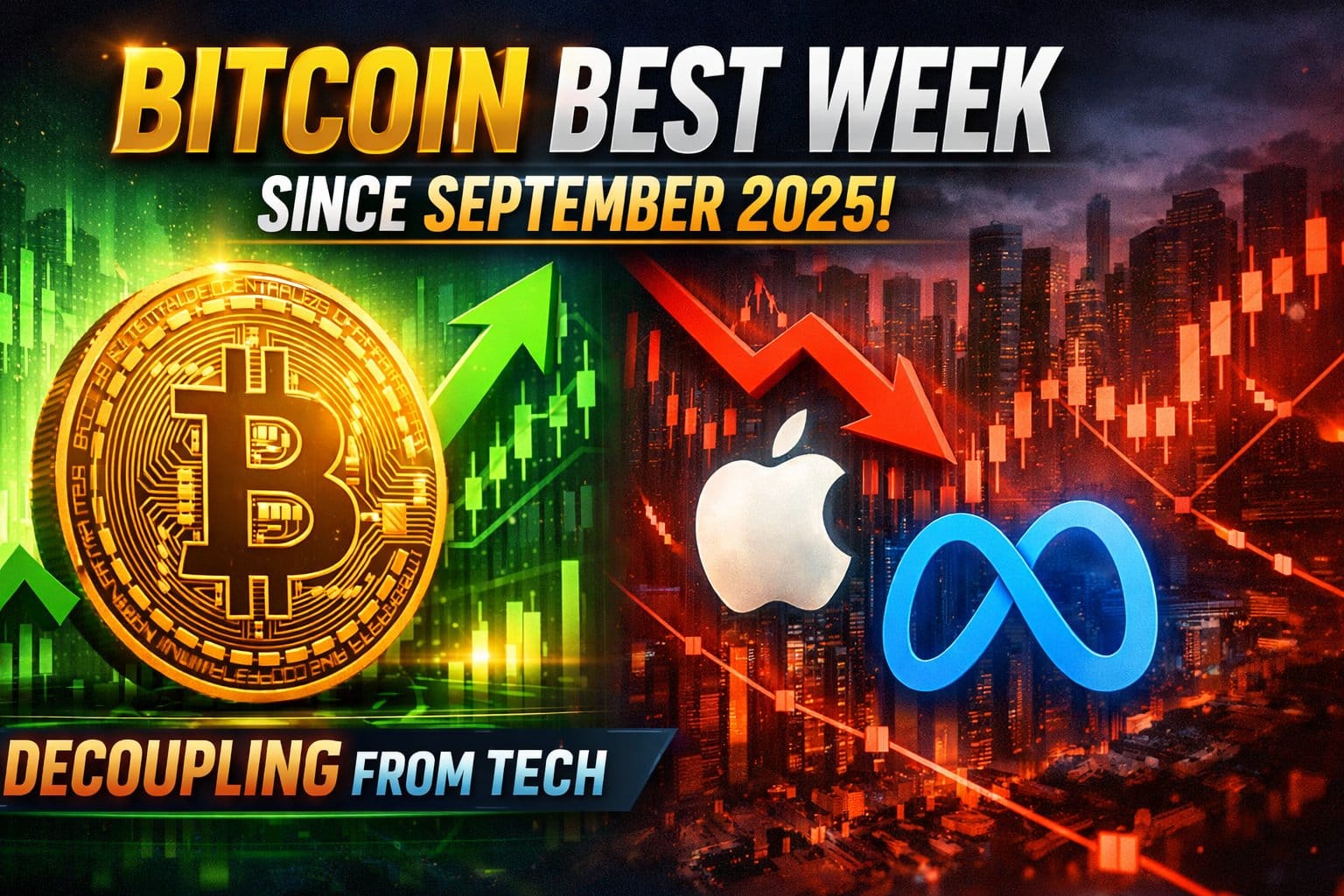
Bitcoin Set for Best Week Since September 2025 as Correlation with Tech Stocks Weakens
In a dramatic shift for digital asset markets, Bitcoin is set for its best weekly performance since September 2025, breaking away from the tech-heavy Nasdaq 100 as macroeconomic crosscurrents reshape investor behavior. The original cryptocurrency surged past $68,000 on Monday morning, capping a seven-day rally of nearly 18%. This decoupling from major equity indices marks a potential turning point for the asset class, which has traded largely in lockstep with growth stocks for the past eighteen months.
🔷 Key observation: The 30-day rolling correlation between Bitcoin and the Nasdaq 100 has dropped to 0.42, its lowest level since the regional banking turmoil in March 2023. As recently as February, that correlation hovered near 0.78. This weakening link suggests that distinct catalysts—ranging from institutional accumulation to unique geopolitical hedging—are now driving Bitcoin’s price action.
Breaking Down the Decoupling: Why Bitcoin Set for Best Week Since September 2025
To understand the significance of this rally, we must revisit the environment of September 2025. Back then, Bitcoin climbed from $52,000 to $61,000 amid expectations of Federal Reserve rate cuts. However, that move was mirrored by the S&P 500. Today’s rally tells a different story. While the Nasdaq is essentially flat over the same period, Bitcoin has charged higher.
Consequently, analysts are pointing to three distinct factors behind this divergence. First, there’s the “ETF reallocation effect” as multi-asset portfolios seek non-correlated returns. Second, we’re witnessing flight-to-quality within the crypto ecosystem itself, moving away from smaller altcoins into Bitcoin. Finally, the recent liquidation data from Coinglass shows a massive short squeeze amplified Bitcoin’s gains once it cleared $64,000.
Institutional Flows: A Key Driver as Bitcoin Set for Best Week
Institutional appetite appears to be a primary catalyst. Data from the TechSpacee Crypto News desk highlights that BlackRock’s latest filings reveal a $600 million accumulation in Bitcoin and Ethereum products last week alone. This isn’t just passive ETF flow; it’s active balance-sheet allocation by sovereign wealth funds and endowments using the spot ETFs as a liquidity sleeve.
Moreover, on-chain metrics reinforce this. The number of addresses holding at least 1,000 BTC has increased by 22 wallets since March 1, 2026. These “whale wallets” are typically associated with deep institutional custody. Therefore, the buying pressure is not merely speculative retail leverage but substantive capital deployment.
Macro Backdrop: Geopolitical Risk and the Weakening Correlation
Interestingly, the geopolitical landscape has played a role in cementing Bitcoin’s status as a “non-correlated asset” this week. As reports surface regarding the evolving situation in the Middle East, Bitcoin’s reaction function has diverged from equities. Traditionally, both assets sold off during geopolitical spikes. However, in the current environment, Bitcoin has exhibited strength similar to its initial response during the Ukraine conflict, as noted in our earlier analysis this week.
One portfolio manager I spoke with described it this way: “Markets are now differentiating between ‘growth shocks’ and ‘monetary shocks.’ Bitcoin is trading like a hard asset with a technological growth option. When the catalyst is inflation or fiscal concerns, it outperforms; when it’s purely about tech earnings, it now moves less.” This nuanced view helps explain why Bitcoin set for best week against a backdrop of flat tech stocks.
Technical Levels and the Path Forward
From a technical perspective, Bitcoin has cleared the $64,500 resistance level that held throughout February. The next major hurdle sits at $72,000, the 2024 highs. Should the correlation continue to weaken, and should Bitcoin hold above $66,000, a retest of the all-time highs near $74,000 becomes plausible before the end of Q2.
However, traders should note that open interest in Bitcoin futures has surged alongside the price, climbing to $32 billion. This sets up the possibility of continued volatility. That said, funding rates remain moderate, suggesting the rally isn’t overheated—yet.
Why This Matters Beyond the Price
The decoupling, if sustained, carries profound implications for portfolio construction. For the last two years, the narrative was that Bitcoin was just a high-beta tech play. A sustained break in that correlation would force institutional allocators to revisit their assumptions. It could lead to a new wave of diversification demand, separate from the “risk-on/risk-off” trade that has dominated.
Additionally, it strengthens the “digital gold” thesis. While gold has also rallied slightly this week, Bitcoin’s magnitude of move suggests it is attracting capital seeking both scarcity and momentum. This hybrid characteristic is exactly what makes the asset class unique.
Looking Ahead: Key Catalysts This Week
As we progress through the week, several events will test whether Bitcoin can maintain its trajectory. Wednesday brings the FOMC minutes, which could reintroduce correlation if they contain major surprises. On Thursday, the TechSpacee crypto news section will cover the latest token unlock data, which may impact sentiment. Friday’s options expiry, with notional value near $8 billion, could also induce volatility.
Nonetheless, the structural shift is evident. Bitcoin set for best week since September 2025 is not just a headline—it’s a signal that market dynamics are evolving. For long-term holders, this week validates the patience of the past eight months. For traders, it’s a reminder that crypto’s relationship with traditional markets is never static.
📌 Bottom line: The data as of March 16, 2026, confirms a regime shift. Whether temporary or permanent, the declining correlation provides Bitcoin with room to assert its own fundamental drivers. We’ll be watching the $68,000-$70,000 zone closely for the next clue.
✍️ Markets Desk · Data sources: Bloomberg, Coinglass, on-chain analytics compiled March 2026.