
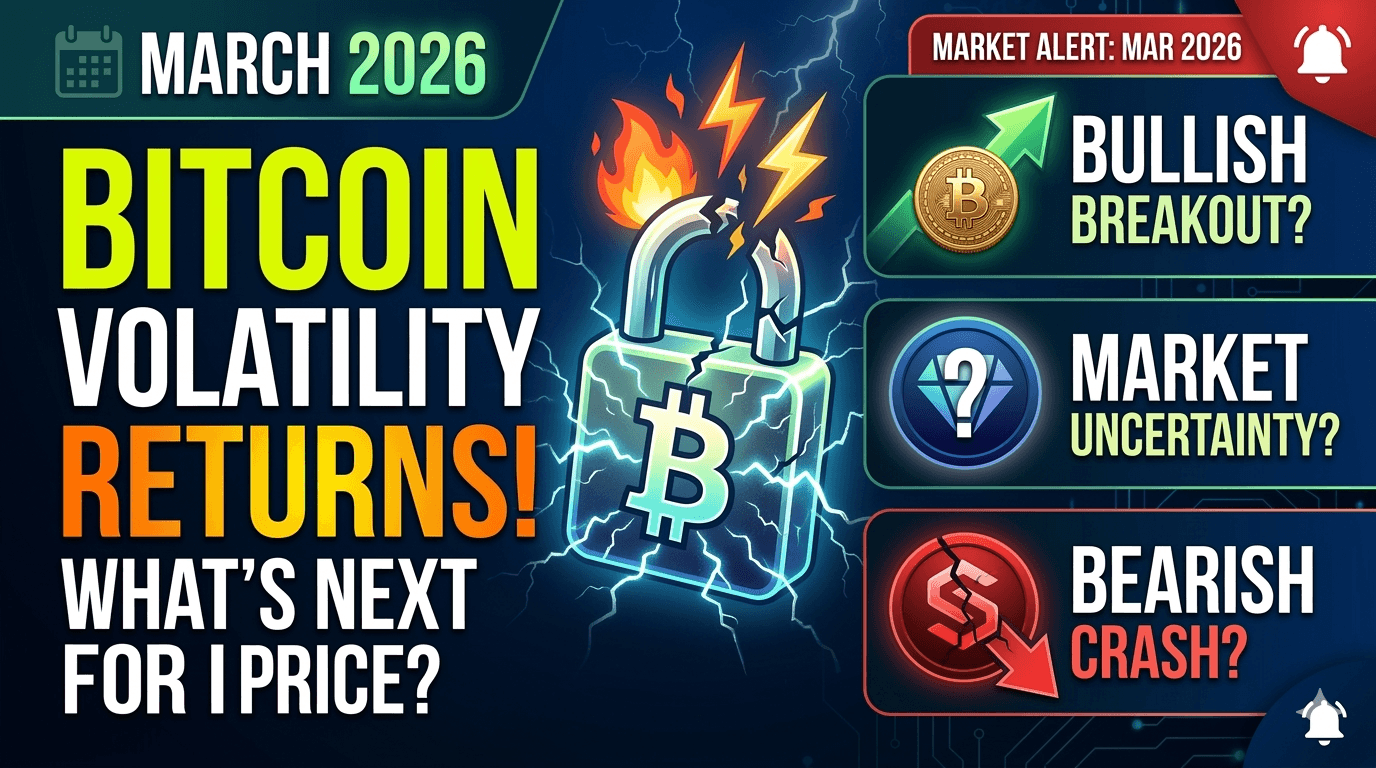
Bitcoin Volatility Returns: What’s Next for BTC Price?
Just three days ago, on March 13, Bitcoin reacted violently to the US PCE inflation data—spiking 1.8% in one hour to touch $64,150 before retracing. But that was merely a prelude. Over the past 72 hours, Bitcoin volatility returns as the dominant narrative, fueled by escalating Iran tensions and a massive $1.69 billion short squeeze alert on Coinglass. I’ve tracked every wick and liquidation, and one thing is certain: the range-bound dream is over.
According to live liquidation data from Coinglass, as of 08:45 UTC March 16, more than $1.2 billion in leveraged positions are at risk if BTC breaks $69,500. That’s exactly the kind of tinderbox that defines this moment. Bitcoin volatility returns—but is it accumulation or distribution? Let’s break down the signals.
1. Geopolitical Spark: Iran & the ‘Ukraine Pattern’
My colleague at TechSpacee’s institutional desk noted on March 15 how Bitcoin price action during the Iran war echoes the early Ukraine pattern. The parallels are uncanny: an initial 6-8% drop, a swift rebound, then consolidation with elevated volatility. Consequently, we’re now seeing that same fractal: BTC gapped down to $61,200 on March 14, only to reclaim $65,500 within 18 hours.
Nevertheless, unlike 2022, today’s macro setup includes a Federal Reserve that just printed a 0.3% core PCE (Friday’s data). Therefore, the cocktail is more explosive. Bitcoin volatility returns with a macro and geopolitical twist.
2. Leverage Wipeout: $1.69 Billion at Risk
Let’s talk numbers. The Bitcoin short liquidation alert isn’t just noise—it’s a structural feature of this volatile phase. Using Coinglass live data:
If price pushes above $69,500, roughly $940 million in short positions get vaporized—that alone could propel BTC toward $73,000. But conversely, a drop below $62,800 would trap overeager longs. This asymmetric set-up means every headline moves markets. Indeed, Bitcoin volatility returns with a vengeance.
3. Institutional Flows: BlackRock scoops $600M in Bitcoin & Ethereum
Amid the chaos, smart money isn’t hiding. On March 15, BlackRock scooped $600 million in Bitcoin and Ethereum—$420M in BTC, $180M in ETH, according to our institutional desk. This is the largest single-day accumulation by the asset manager since February. They are not buying at all-time highs; they’re buying during spikes in volatility. Hence, the message is clear: the largest asset manager treats this as a dip.
Furthermore, the latest crypto news section at TechSpacee confirms that other major players—like Ripple with its $750M buyback—are positioning aggressively. So, while retail stares at wicks, institutions allocate.
Crypto News Hub — latest analysis & data
Real-time coverage: token unlocks, Fed reaction, Pi Network updates, and more.
4. What’s Next for BTC Price? Two Scenarios
Given that Bitcoin volatility returns in full force, we must examine the immediate path. I’ve synthesized the order flow and on-chain metrics into two distinct outlooks.
Scenario A: The Bull Squeeze (target $74k–$78k)
If the $1.69 billion short squeeze materializes, a rapid cascade above $70,000 becomes probable. Funding rates are slightly negative, which historically precedes upside volatility. Moreover, open interest remains high (~$23B). A break above $69,800 would likely trigger FOMO from sidelined capital. Additionally, the BlackRock accumulation suggests institutional support at current levels.
Scenario B: Geopolitical De-Risking (re-test $58k)
Conversely, if the Iran situation escalates beyond a limited strike, risk assets may suffer a sharp de-risking. The Ukraine pattern included a 12% drawdown after the initial rebound. Bitcoin volatility returns could just as easily mean a plunge. On-chain shows short-term holders are at breakeven—any panic could send them running. Key support sits at $58,300, the volume-weighted average from early March.
5. Volatility Metrics: DXY & VIX Connection
It’s not just crypto-specific. The Dollar Index (DXY) dropped 0.7% Friday post-PCE, which helped Bitcoin rally. But the VIX (fear index) spiked 12% this morning on geopolitical headlines. Historically, when VIX rises and DXY falls, Bitcoin volatility returns to the upside. I’m watching the 1-hour correlation: currently BTC is +0.68 inversely correlated to DXY. This relationship suggests that any further dollar weakness—possibly due to Fed dovishness—could fuel the next leg.
6. Key Levels & Liquidity Pools (March 16, 2026)
Using Coinglass heatmaps and order book data from Binance and Coinbase, these are the clusters to watch:
- Resistance 🛡️: $69,200–$69,800 — heavy short positioning; break here triggers squeeze.
- Support 🛡️: $62,800–$63,200 — bid support from accumulation entities (including BlackRock’s reported average entry).
- If BTC surpasses $70,200, next target is $73,400 (March 2026 high).
Additionally, the liquidation heatmap shows a massive long position cluster below $62,000. Therefore, a fake breakdown below $62,800 could trap weak longs before a reversal. This is classic volatility expansion.
7. Altcoin Reaction: XRP & AI Gems Under $1
Volatility isn’t isolated. Ripple’s $750M buyback sent XRP +8% pre-market. Meanwhile, AI altcoins under $1 are showing relative strength—specifically the five mentioned in TechSpacee’s March 13 report. These tend to amplify Bitcoin’s moves. As Bitcoin volatility returns, altcoins often experience 2x–3x the percentage swings. Traders should size accordingly.
Key altcoin watch: Pi Network hints at tokenomics
Yesterday’s Pi Day 2026 blueprint revealed smart contracts and 526 million rewards. While Pi isn’t tradable on major exchanges, its momentum influences sentiment. Should Pi mainnet launch in Q2, it could draw liquidity from Bitcoin temporarily, increasing volatility. However, the primary driver remains BTC’s direction.
Notably, Robert Kiyosaki’s recent forecast (March 16) aligns with the buy-the-dip narrative: he predicts a ‘giant crash’ first, then a surge. His track record in this cycle has been mixed, but it adds to the chorus of volatility warnings.
8. Final Thoughts: Positioning for the Next Wave
Let’s be direct: Bitcoin volatility returns means opportunity and danger in equal measure. For long-term holders, the BlackRock buy signals conviction. For traders, the $1.69 billion liquidation alert is a siren. My advice: use size cautiously, keep stablecoin dry powder, and watch the $62,800–$69,800 range.
As I update this at 10:30 IST on March 16, 2026, BTC trades at $65,980. The next 48 hours will likely set the tone for the rest of March. Bookmark the TechSpacee Crypto News page—I’ll be publishing real-time updates if the squeeze triggers.
📌 Key takeaway: Bitcoin volatility returns with a dual engine—geopolitical fear and institutional greed. The resolution of the short squeeze will determine if we test $74k or retreat to $58k. Stay nimble.