
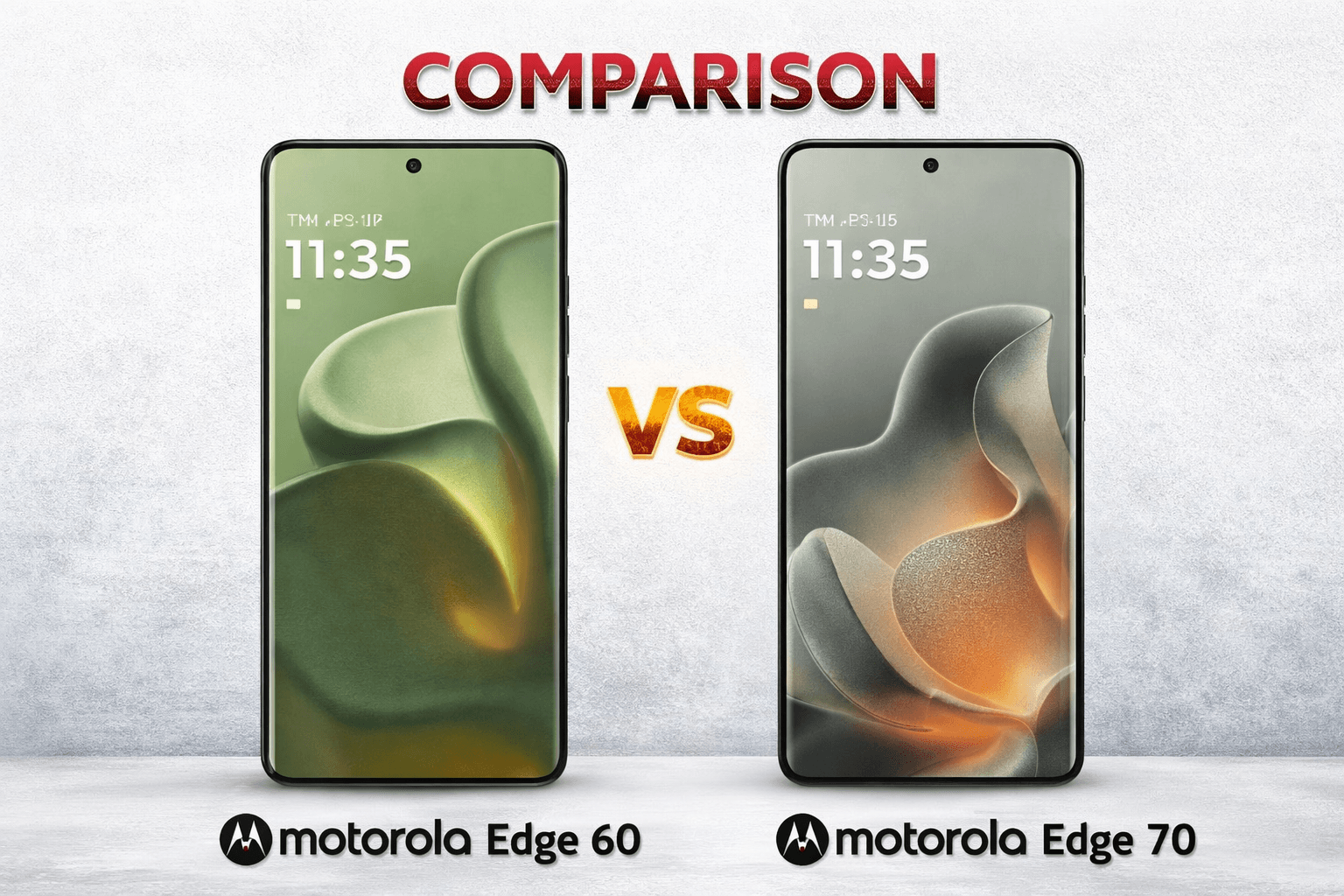
Choosing between the Motorola Edge 60 and the Motorola Edge 70 comes down to a choice between versatile camera optics and ultra-slim modern design.
As the smartphone market moves toward 2026, Motorola has shifted its strategy. While the Edge 60 focuses on being a well-rounded premium mid-ranger, the Edge 70 is designed to be one of the thinnest smartphones ever made.
Key Differences: Motorola Edge 60 vs. Motorola Edge 70
| Feature | Motorola Edge 60 | Motorola Edge 70 |
| Launch Date | April 2025 | November 2025 |
| Thickness | ~8.2 mm | 5.99 mm (Ultra-slim) |
| Weight | 181g | 159g |
| Display | 6.67″ Curved pOLED | 6.7″ Flat AMOLED |
| Processor | MediaTek Dimensity 7400 | Snapdragon 7 Gen 4 |
| Rear Camera | 50MP + 50MP + 10MP (3x Zoom) | 50MP + 50MP |
| Battery | 5,500 mAh | 5,000 mAh |
| OS Version | Android 15 | Android 16 |
Export to Sheets
1. Design & Build: Aesthetics vs. Portability
The most striking difference is the physical profile.
- Motorola Edge 60: Features a traditional “Edge” identity with a quad-curved display that feels premium and immersive. It is slightly thicker but provides a solid grip.
- Motorola Edge 70: Aimed at the “slim-phone” trend of 2026. At just 5.99mm, it is significantly thinner and lighter, rivaling models like the iPhone Air. It switches to a flat display, which many users prefer for durability and accidental touch prevention.+2
2. Performance & Software
- Edge 60: Powered by the MediaTek Dimensity 7400. It is a reliable workhorse for multitasking and moderate gaming, running on Android 15.+1
- Edge 70: Features the newer Snapdragon 7 Gen 4 chipset. Not only does this offer better power efficiency, but it also ships with Android 16 out of the box, ensuring an extra year of software support compared to its predecessor.+1
3. Camera Systems: Zoom vs. AI Simplicity
- Edge 60 (The Photographer’s Choice): It includes a dedicated 10MP Telephoto lens with 3x optical zoom. This makes it superior for portrait photography and capturing distant subjects.
- Edge 70 (The AI-Driven Choice): It lacks a telephoto lens, opting for a dual 50MP setup. However, it compensates with Moto AI enhancements and newer sensor technology (Sony LYTIA 710) for better low-light performance and smarter image processing.
4. Battery & Charging
- Edge 60: The thicker chassis allows for a larger 5,500 mAh battery, making it the winner for heavy users who need two-day battery life.
- Edge 70: Despite its thinness, it houses a respectable 5,000 mAh battery. While slightly smaller, its more efficient Snapdragon processor helps it easily last a full day. Both support 68W TurboPower charging.+1
Which One Should You Buy?
Choose the Motorola Edge 60 if: You want a curved, immersive display, better battery life, and a dedicated zoom lens for photography.
Choose the Motorola Edge 70 if: you want the latest software (Android 16), a flat screen, and an incredibly thin, lightweight design that is easy to carry.
Would you like me to compare the “Pro” or “Fusion” versions of these models as well?
FAQ
1. Which Moto Edge series is best?
The best Moto Edge series phone depends on your budget and usage needs. In Motorola’s premium lineup, the Motorola Edge 50 Ultra is considered one of the best due to its powerful Snapdragon processor, high-refresh-rate pOLED display, premium design, and fast charging support. For upper mid-range users, the Motorola Edge 50 Pro offers strong performance, good cameras, and a sleek curved display at a more affordable price. If you want a balance between performance and price, the Edge 50 or Edge 60 series models are solid choices. Overall, the “best” model depends on whether you prefer flagship performance, camera quality, or value for money.
2. Is Edge 70 a curved display?
As of now, Motorola has not officially launched a model called “Edge 70.” Most recent Moto Edge smartphones, such as the Motorola Edge 50 Pro and Motorola Edge 40, feature curved pOLED displays. If Motorola launches an Edge 70 in the future, it is likely to continue the brand’s trend of offering curved-edge displays in the Edge series. However, users should always check official specifications before purchasing.
3. Which is better Motorola Edge 60 or Edge 60 Fusion?
The better option between the Motorola Edge 60 and Motorola Edge 60 Fusion depends on performance and features. Typically, the standard Edge model offers a slightly more powerful processor and better overall camera system, while the Fusion variant is designed to be more affordable with balanced specifications. Both models usually come with high-refresh-rate OLED displays and clean Android software. If you want better performance and premium features, the Edge 60 is the better choice. If you prefer value for money, Edge 60 Fusion is a practical option.
4. Which is better, AMOLED or curved?
AMOLED and curved are two different things. AMOLED is a display technology known for deep blacks, vibrant colors, and better power efficiency. A curved display refers to the physical shape of the screen edges. Most Moto Edge phones use pOLED (plastic OLED), which is similar to AMOLED in quality. In terms of display quality, AMOLED is more important than whether the screen is curved. Curved displays look premium and immersive but can sometimes lead to accidental touches. For practical use and durability, display technology (AMOLED/pOLED) matters more than the curved design.
5. What are common problems with Moto Edge?
Some users of Moto Edge smartphones have reported issues such as battery drain after software updates, heating during heavy gaming, occasional camera lag, and accidental touches on curved screens. Earlier Edge models were also reported to have display tint or green line issues in rare cases. However, Motorola generally provides software updates to fix bugs and improve stability. Most problems depend on usage patterns and specific models, so checking recent user reviews before buying is recommended.
6. Is the Motorola Edge 60 good or bad?
The Motorola Edge 60 is generally considered a good mid-range smartphone. It typically offers a smooth 120Hz or higher OLED display, near-stock Android experience, solid build quality, and decent cameras for everyday photography. It is good for users who want clean software without heavy bloatware. However, heavy gamers or users looking for top-tier flagship performance may find it less powerful compared to premium models. Overall, it is a good choice for balanced performance, display quality, and value for money.