
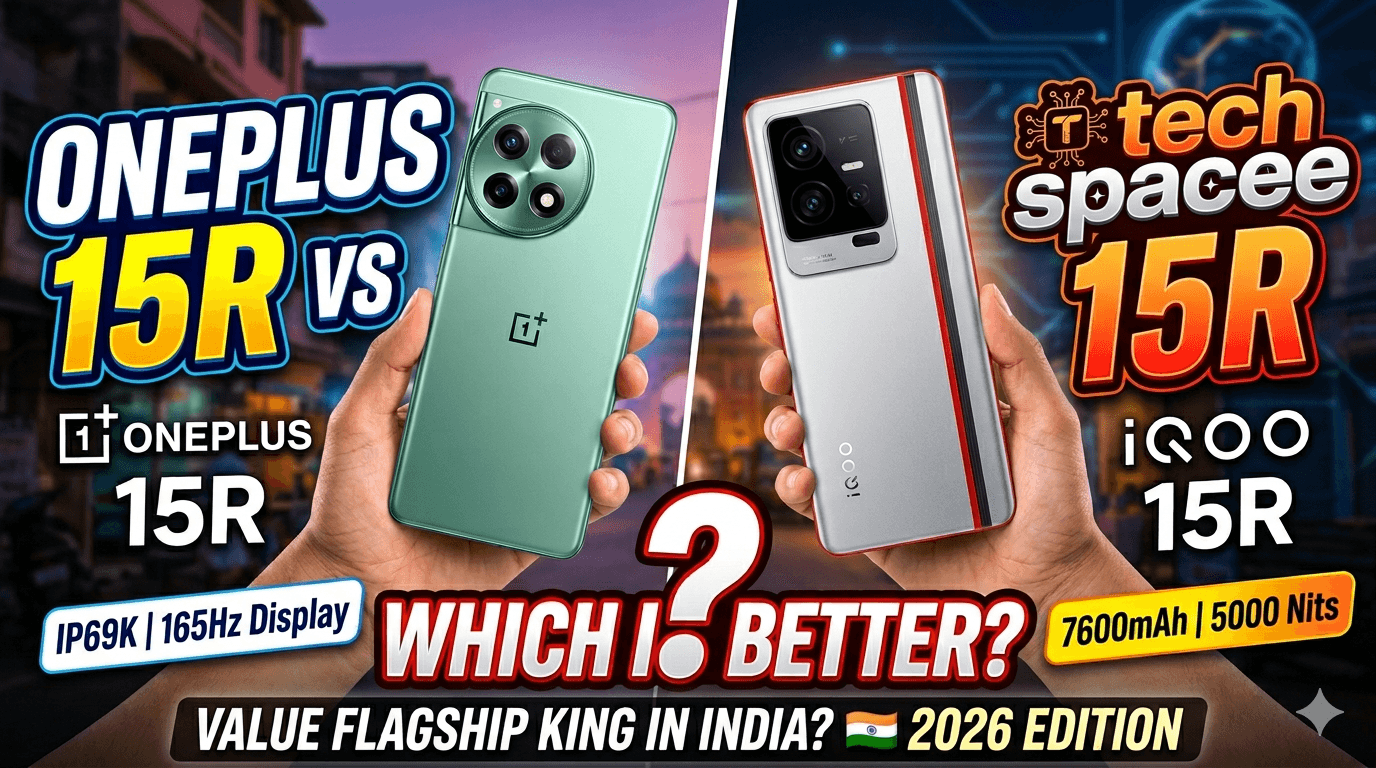
OnePlus 15R vs iQOO 15R: Which “Value Flagship” King Should You Buy in India?
The Indian smartphone market in 2026 has become a battlefield of numbers. If you have a budget of around ₹45,000 to ₹50,000, you are no longer looking at “lite” versions of flagships. You are looking at absolute monsters. Two names are currently dominating the conversation: the OnePlus 15R and the iQOO 15R.
Both phones are powered by the same silicon heart—the Snapdragon 8 Gen 5—and both promise to last longer than your average workday. But while they look similar on a spec sheet, they feel like two completely different animals once you actually start using them.
After spending quality time with both, I’ve broken down this comparison into what actually matters: real-world speed, camera reliability, and that “feel” that makes a phone worth your hard-earned money.
1. Design and Build: Refined Elegance vs. Raw Aggression
When you pick up the OnePlus 15R, it feels like a continuation of the brand’s premium legacy. It’s slightly heavier at 213g, but that weight is balanced. The curved edges make it feel thinner than its 8.1mm profile suggests. One huge win for OnePlus this year is the IP69K rating. It doesn’t just survive a drop in the sink; it’s designed to withstand high-pressure, high-temperature water jets. If you’re clumsy or live in a rainy city, this is peace of mind you can’t ignore.
The iQOO 15R, on the other hand, is a bit sleeker and lighter (202g). It feels more agile. It carries an IP68/IP69 rating, which is still top-tier, but it lacks that extra “K” protection found on the OnePlus. The design language here screams “speed.” While OnePlus goes for sophisticated textures like Mint Breeze and Electric Violet, iQOO sticks to its sporty roots with the Triumph Silver and Dark Knight editions.
The Verdict on Design: If you want a phone that looks “professional” and is built like a tank, go for OnePlus. If you prefer a lighter, more nimble device that fits better in tight pockets, iQOO takes the lead.
2. The Display Battle: 165Hz vs. 5000 Nits
This is where the competition gets interesting.
- OnePlus 15R: It features a massive 6.83-inch 1.5K AMOLED panel. The headline here is the 165Hz refresh rate. In daily use—scrolling through Twitter (X) or navigating the UI—it feels noticeably more fluid than standard 120Hz screens. OnePlus has also added a dedicated touch response chip with 3200Hz sampling. For gamers, this means the gap between your thought and the on-screen action is virtually zero.
- iQOO 15R: It uses a slightly smaller 6.59-inch screen. While the refresh rate is “only” 144Hz, it counters with a staggering 5,000 nits peak brightness. In the harsh Indian summer sun, the iQOO is undeniably easier to read. Colors pop with a bit more saturation, making it a fantastic device for watching movies or YouTube.
The Verdict on Display: Gamers should lean toward the OnePlus for that 165Hz fluidity. Outdoor users and movie buffs will likely prefer the sheer brilliance of the iQOO’s 5000-nit panel.
3. Performance: The Snapdragon 8 Gen 5 Showdown
Both phones use the Snapdragon 8 Gen 5, but they “drive” that engine differently.
The iQOO 15R is unashamedly a gaming beast. It includes the Q2 Super Computing Chip, which helps in frame interpolation and upscaling game resolution. In AnTuTu benchmarks, the iQOO consistently scores higher (around 3.5 million) because its 6.5K VC Cooling System is massive. It stays cooler for longer during intense sessions of Genshin Impact or BGMI.
The OnePlus 15R isn’t far behind, scoring around 2.9 to 3 million. While it might throttle slightly earlier than the iQOO under extreme stress, it feels “snappier” in everyday tasks. This is largely due to OxygenOS 16. It is cleaner, has less bloatware, and feels more intuitive than iQOO’s OriginOS 6. OnePlus also offers a 16GB RAM variant at the top end, which is a big deal if you are a heavy multitasker who keeps 50+ apps open in the background.
4. Cameras: More than Just Megapixels
On paper, both have a 50MP primary + 8MP ultrawide setup. But the sensors tell a different story.
- OnePlus 15R: It uses the Sony IMX906 (the same sensor as the flagship OnePlus 15). The “DetailMax Engine” does a great job with skin tones and dynamic range. But the real “Pro” feature is 4K video at 120fps. If you like shooting cinematic slow-motion videos for Instagram or YouTube, OnePlus is the only choice here. Also, the 32MP selfie camera has autofocus, which makes a world of difference for vloggers.
- iQOO 15R: It uses the Sony LYT-700V. It’s a great sensor for “social media ready” photos—slightly boosted colors and high contrast. Night mode is impressive, but it lacks the video versatility of the OnePlus. The ultra-wide lens on both is just “okay”—good for daylight, but noisy in low light.
5. Battery and Charging: The 7000mAh Club
We’ve finally reached the era of the “Two-Day Battery.”
- iQOO 15R: Leads the pack with a 7,600mAh battery and 100W Flash Charge. You can go from 0 to 100% in about 35-40 minutes. It also supports Bypass Charging, which allows the phone to pull power directly from the charger without heating up the battery—perfect for gaming while plugged in.
- OnePlus 15R: Houses a 7,400mAh unit with 80W SuperVOOC. It’s slightly slower, taking about 45-50 minutes for a full charge. However, in my testing, the software optimization on OxygenOS meant the OnePlus actually had better standby times.
Comparison Table: At a Glance
| Feature | iQOO 15R | OnePlus 15R |
| Price (Base) | ₹44,999 (8GB/256GB) | ₹47,999 (12GB/256GB) |
| Display | 6.59″ 144Hz (5000 nits) | 6.83″ 165Hz (1800 nits HBM) |
| Processor | Snapdragon 8 Gen 5 + Q2 | Snapdragon 8 Gen 5 + Gaming Core |
| Battery | 7,600mAh | 7,400mAh |
| Charging | 100W Flash Charge | 80W SuperVOOC |
| Main Camera | 50MP Sony LYT-700V | 50MP Sony IMX906 |
| Video | 4K @ 60fps | 4K @ 120fps (Slow-Mo) |
| IP Rating | IP68 / IP69 | IP66 / IP68 / IP69 / IP69K |
Final Verdict: Which One Should You Buy?
Choosing between these two comes down to your personal “User Profile.”
Buy the OnePlus 15R if:
- You want the cleanest software experience (OxygenOS).
- You are a content creator who needs 4K 120fps video and selfie autofocus.
- You want the smoothest 165Hz display for daily scrolling and gaming.
- You need a “rugged” flagship that can survive almost any environment (IP69K).
Buy the iQOO 15R if:
- You are a hardcore gamer who values cooling and the Q2 gaming chip.
- You want the absolute fastest charging and a massive 7,600mAh battery.
- You often use your phone in direct sunlight (5000 nits is a lifesaver).
- You want the best value for money (the ₹44,999 starting price is a steal).
Both phones are incredible achievements for 2026. You really can’t go wrong with either, but for me, the OnePlus 15R feels like the more “complete” smartphone for a general user, while the iQOO 15R remains the undisputed king of performance-per-rupee.
Frequently Asked Questions (FAQs)
- 1. Does the OnePlus 15R support wireless charging?
- No, both the OnePlus 15R and iQOO 15R skip wireless charging to keep the costs down and make room for those massive 7,000mAh+ batteries.
- 2. Which phone is better for long-term use (4-5 years)?
- OnePlus generally has a better track record with software polish over time. Both offer 4 years of OS updates, but OxygenOS usually feels “fresher” for longer compared to the feature-heavy OriginOS.
4. Can the iQOO 15R handle heavy 4K video editing?
Absolutely. The Snapdragon 8 Gen 5 is a beast. However, for exporting and previewing, the OnePlus 15R’s 16GB RAM variant might give you a slightly smoother experience.
5. Are these phones too big for one-handed use?
Yes, they are both large devices. The iQOO is slightly narrower and lighter, making it a bit more manageable, but you’ll likely need both hands for most tasks on either phone.