
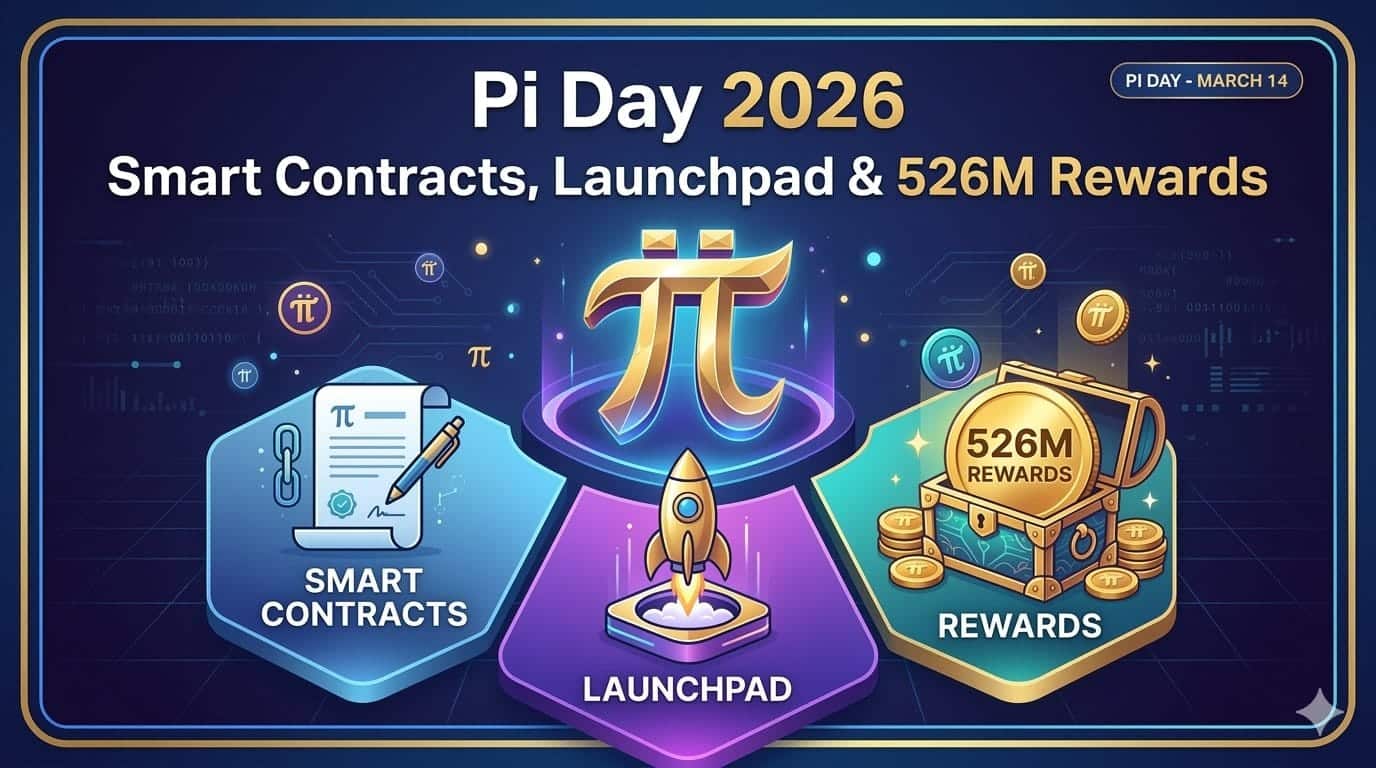
Pi Day 2026: Smart Contracts, Token Launchpad and 526 Million Rewards; Pi Network’s Biggest Update in 7 Years
Yesterday, on March 14, 2026, the crypto community witnessed a massive shift. The highly anticipated Pi Day 2026 update arrived, bringing with it structural changes that shift the project from a simple mobile mining app into a fully functioning, utility-driven blockchain. Marking its seventh anniversary, the core development team released actual, live products rather than just roadmap promises.
This event is officially being called Pi Network’s Biggest Update in 7 Years. With the introduction of the new Token Launchpad on Testnet, the activation of Smart Contracts via Protocol 20, and an enormous distribution of 526 Million Rewards for KYC validators, the network is fundamentally changing how its 17.7 million verified Mainnet users interact with decentralized applications.
Unpacking the Pi Day 2026 Update and Protocol 20
For years, users have waited for the network to transition from a closed ecosystem to an open developer environment. The announcements from this recent Pi Day 2026 update prove that the infrastructure is finally ready for complex decentralized finance (DeFi) tools.
Protocol 20 and the Arrival of Smart Contracts
The foundation of this transformation is Protocol 20. As of March 13, all major Pi nodes upgraded to version 20.2, officially supporting this new protocol. The full Mainnet upgrade is wrapping up this week. This is incredibly important because Protocol 20 introduces the technical layer needed for Smart Contracts on the Pi blockchain.
Developers now have the programmable logic necessary to build decentralized applications directly on the network. This means we will soon see automated transactions, non-fungible tokens (NFTs), escrow systems, and subscription models natively built on the blockchain. The rollout of these smart contracts will happen gradually, focusing purely on real-world utility rather than speculative hype.
The Pi Launchpad Goes Live on Testnet
Another major pillar of the Pi Day 2026 update is the new Token Launchpad. Currently live on the Testnet, this platform is specifically built for product-first developers. It operates on a completely different philosophy compared to standard crypto launchpads.
To use the Pi Launchpad, a project must already have a working, functional application. The token they create is meant to acquire real users and integrate into the product’s actual features, not just serve as a fundraising tool. Additionally, the proceeds from token offerings go straight into a liquidity pool rather than the developer’s pockets. This ensures a healthy baseline of liquidity from the very first day of trading.
Breaking Down the 526 Million Rewards and KYC Milestones
Validating millions of real human users is difficult, but the network managed to process a staggering volume of KYC approvals leading up to the Pi Day 2026 update. The team announced extensive rewards to compensate the community members who made this possible.
More than 1.09 million validators successfully completed over 526 million successful human validations. To recognize this massive effort, the core team distributed a huge compensation package.
| Metric | Data from Pi Day 2026 Update |
|---|---|
| Total Human Validations | Over 526 Million |
| Active Validators | 1.09 Million Users |
| Base Reward Pool | 16.57 Million PI |
| Foundation Bonus | 10 Million PI Added |
| Price Per Validation | 0.0504 PI (21x the current base mining rate) |
| Verified Mainnet Pioneers | 17.7 Million Users |
These 526 Million Rewards are currently being distributed over a ten-day period directly into the validators’ Mainnet wallets. This injection of tokens rewards the community while also testing the transaction capacity of the newly upgraded network.
Market Reaction: Kraken Listing and Second Migrations
Just one day before the massive Pi Day 2026 update, the cryptocurrency exchange Kraken officially listed the $PI token for trading on March 13. This listing represents a turning point, providing the asset with much-needed market accessibility and liquidity.
The cryptocurrency market moves fast, and sudden changes in liquidity or exchange listings can cause massive price action. Just as traders watch out for major market events—like the recent Bitcoin short squeeze alert detailing a 1 billion liquidation—investors are paying close attention to how $PI performs now that it is trading on a top-tier centralized exchange. While the price saw a slight dip following the initial listing hype, the trading volume remains steady around the $0.19 to $0.20 mark.
Second Migrations Open the Doors
Finally, as part of Pi Network’s Biggest Update in 7 Years, the team initiated “Second Migrations.” This feature allows pioneers who have already passed KYC and migrated their initial balances to move their newly mined tokens and referral bonuses onto the Mainnet. This gradual rollout brings even more circulating supply to the ecosystem, which will be essential for funding the new smart contracts and decentralized applications launching through the Testnet Token Launchpad.
Official Source Check: For the exact technical details regarding node configuration for Protocol 20, developers should refer directly to the official Pi Network blog to ensure their systems are correctly synced.
What This Pi Day 2026 Update Means Moving Forward
The changes introduced yesterday prove that the development team is focused on long-term, stable growth. By enforcing rules like requiring working applications for the Token Launchpad and prioritizing liquidity pools over developer payouts, the network is protecting its users from low-quality projects.
The successful execution of Smart Contracts, the introduction of the Token Launchpad, and the massive distribution of 526 Million Rewards show that the infrastructure is finally catching up to the size of its massive community. As the remaining nodes finish their Protocol 20 upgrades this week, the real test begins: seeing what the 17.7 million users build and trade in this newly opened environment.