
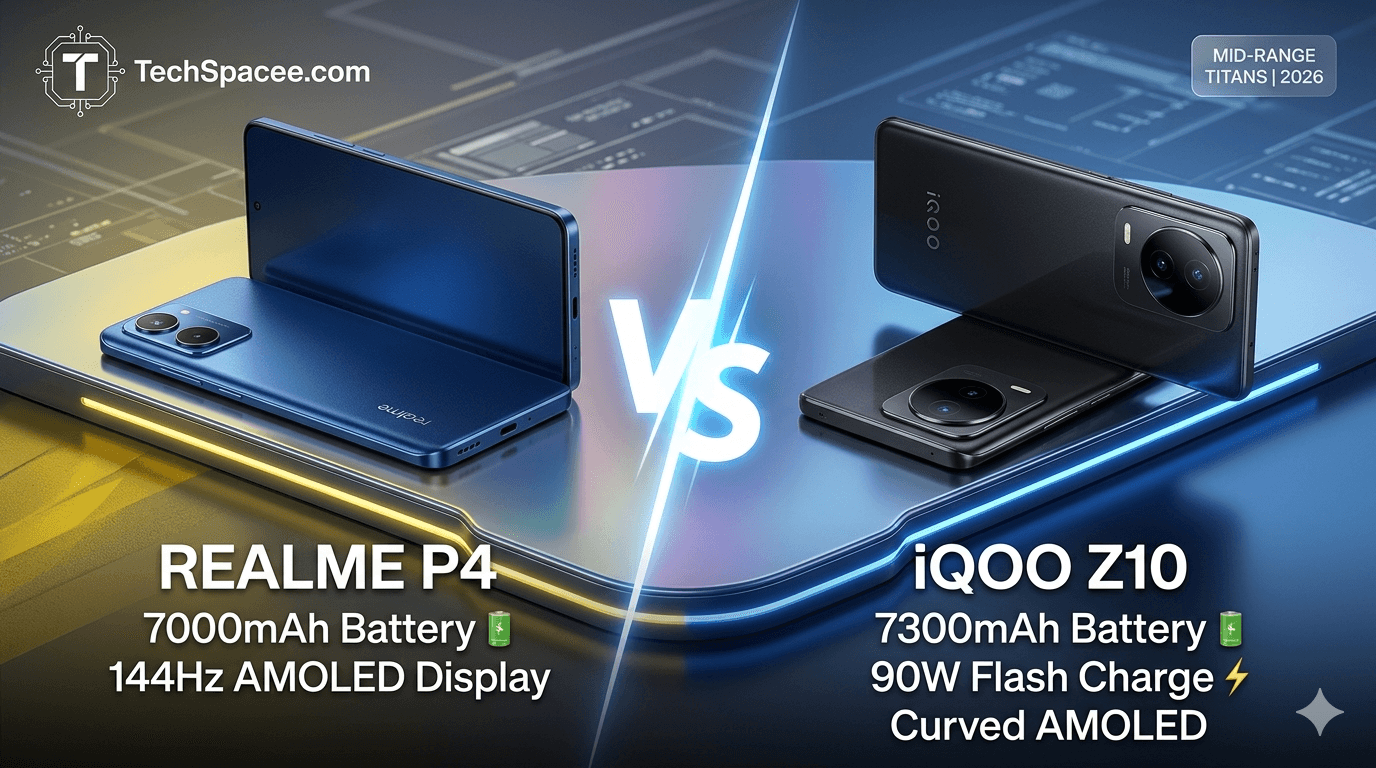
Realme P4 vs iQOO Z10: Which Mid-Range Titan Reigns Supreme in 2026?
The mid-range smartphone market in 2026 has become a battlefield of specs, where brands are no longer just competing on price but on how much “flagship” experience they can cram into a sub-₹25,000 device. Two of the most talked-about contenders right now are the Realme P4 and the iQOO Z10.
Both brands have built their reputations on different pillars: Realme focuses on a balance of aesthetics and massive batteries, while iQOO (a sub-brand of Vivo) targets the performance-hungry crowd and gamers. But with the launch of the Realme P4 and the iQOO Z10, the lines are blurring. If you have roughly ₹20,000 to ₹25,000 in your pocket, choosing between these two isn’t easy.
In this deep-dive comparison, we’ll break down everything—from the silicon under the hood to the curves of the glass—to see which one actually deserves your hard-earned money.
The Core Specifications: A Quick Glance
Before we jump into the experience, let’s look at the raw numbers. In the tech world, numbers don’t always tell the whole story, but they certainly set the stage.
| Feature | Realme P4 5G | iQOO Z10 5G |
| Processor | MediaTek Dimensity 7400 Ultra (4nm) | Qualcomm Snapdragon 7s Gen 3 (4nm) |
| Display | 6.77″ AMOLED, 144Hz Refresh | 6.77″ Curved AMOLED, 120Hz Refresh |
| Peak Brightness | 4500 Nits | 5000 Nits |
| Rear Camera | 50MP (Main) + 8MP (Ultrawide) | 50MP (OIS Main) + 2MP (Depth) |
| Front Camera | 16MP | 32MP |
| Battery | 7000 mAh | 7300 mAh |
| Charging | 80W SuperVOOC | 90W Flash Charge |
| OS | Android 15 (Realme UI 6) | Android 15 (Funtouch OS 15) |
| Starting Price | ~₹18,999 | ~₹21,999 |
Design and Build Quality: Curves vs. Comfort
When you first hold these devices, the difference in philosophy is immediate.
The iQOO Z10 goes for the “premium flagship” look with its Quad-Curved AMOLED display. It feels incredibly sleek in the hand, almost masking its 7.89mm thickness. The curves make the bezels look practically non-existent, giving you an immersive feel that usually costs double this price. However, curves can be polarizing; some people find them prone to accidental touches, though iQOO’s palm-rejection software has improved significantly.
On the other hand, the Realme P4 is a bit more practical but equally eye-catching. It’s slightly lighter at 185g (compared to iQOO’s 199g) and thinner at 7.58mm. Realme has experimented with textures here—the “Steel Grey” and “Engine Blue” variants have a distinct aesthetic that feels modern. While it doesn’t have the extreme quad-curves of the iQOO, it features a sophisticated “HyperGlow” finish that hides fingerprints remarkably well.
Winner: iQOO Z10 for the premium “wow” factor, but Realme P4 for those who prefer a lighter, more ergonomic flat-ish feel.
Display Performance: 144Hz vs. 5000 Nits
This is where the competition gets interesting.
The Realme P4 offers a 144Hz refresh rate. If you are a hardcore gamer or someone who loves buttery smooth scrolling, that extra jump from 120Hz to 144Hz is noticeable, especially in supported titles like BGMI or CoD Mobile. The color calibration is punchy, typical of Realme’s AMOLED panels, and the 2500Hz instantaneous touch sampling rate makes it incredibly responsive.
The iQOO Z10, however, fights back with sheer brilliance—literally. It hits a local peak brightness of 5000 nits. Even under the direct, harsh Indian summer sun, this screen is perfectly legible. While its refresh rate tops out at 120Hz, it compensates with better HDR10+ support and a display that feels slightly more “infinite” due to the curved edges.
Winner: Realme P4 for gamers (144Hz); iQOO Z10 for media consumers (Brightness & Curves).
Performance and Gaming: Dimensity vs. Snapdragon
The heart of these phones determines how they’ll feel two years from now.
The Realme P4 uses the MediaTek Dimensity 7400 Ultra. MediaTek has come a long way, and this 4nm chip is a beast in the mid-range. It manages heat exceptionally well. In our testing, the Realme P4 held its frame rates consistently during long gaming sessions without hitting that uncomfortable “hot spot” near the camera module.
The iQOO Z10 opts for the Snapdragon 7s Gen 3. Qualcomm’s 7-series has always been the gold standard for stability. While the raw AnTuTu scores are close (both hovering around the 800k mark), the Snapdragon chip often has better optimization for certain apps and games. iQOO also includes a dedicated game mode that allows for better resource allocation.
One major differentiator is the RAM and Storage type. The Realme P4 uses UFS 3.1 storage, which is faster for opening large apps and moving files than the UFS 2.2 found in the base variant of the iQOO Z10.
Winner: Realme P4 (Faster storage and higher refresh rate make it feel snappier in daily tasks).
The Battle of the Batteries: 7000 mAh vs. 7300 mAh
We have officially entered the era of the “Two-Day Battery.”
Realme changed the game by putting a 7000 mAh battery in a phone that’s only 7.58mm thick. It’s an engineering marvel. You can easily get through a day of heavy 5G usage, gaming, and navigation and still have 40% left at bedtime. The 80W charging gets you from 1% to 50% in about 25 minutes.
But iQOO went even further. The iQOO Z10 packs a 7300 mAh monster. This is currently one of the biggest batteries in a mainstream smartphone. Combined with 90W Flash Charging, it’s a powerhouse. Because the Snapdragon 7s Gen 3 is quite power-efficient, the standby times on the Z10 are phenomenal.
Winner: iQOO Z10 (Slightly larger capacity and faster charging).
Camera Capabilities: Quality vs. Versatility
Most mid-range phones have one good camera and a few “filler” sensors. These two are no different, but they prioritize differently.
- Realme P4: It features a 50MP main sensor paired with an 8MP Ultrawide. In 2026, I still believe an ultrawide lens is essential. It allows for those dramatic landscape shots or group photos that a primary lens just can’t capture. The daytime photos are sharp with slightly boosted “Instagram-ready” colors.
- iQOO Z10: It uses the Sony IMX882 sensor with OIS (Optical Image Stabilization). This is a big deal. OIS helps significantly with night photography and shaky video. However, iQOO made the frustrating choice to pair it with a 2MP depth sensor. No ultrawide here. It does, however, have a superior 32MP selfie camera, which blows Realme’s 16MP shooter out of the water for video calls and vlogging.
Winner: Realme P4 for the Ultrawide versatility; iQOO Z10 for better Selfies and Night shots (thanks to OIS).
Software and Longevity
Both phones run Android 15, but the skins are worlds apart.
- Realme UI 6 is clean, highly customizable, and feels a bit closer to “Global” tastes.
- Funtouch OS 15 on the iQOO is feature-rich but still comes with a fair amount of pre-installed apps (bloatware) that you’ll need to spend 10 minutes uninstalling.
Realme is promising 3 years of OS updates and 4 years of security patches for the P4, which gives it a slight edge over iQOO’s 2-year OS update cycle for the Z-series.
Final Verdict: Which One Should You Buy?
The “Best” phone depends entirely on what you value more:
Buy the Realme P4 if:
- You want the best value for money (it’s generally ₹2,000–₹3,000 cheaper).
- You are a gamer who wants that 144Hz edge.
- You actually use the Ultrawide camera for landscapes.
- You want a lighter, thinner device that’s easier to use one-handed.
Buy the iQOO Z10 if:
- You want the “Premium” look of a curved display.
- You spend a lot of time outdoors and need that 5000-nit brightness.
- You want the absolute maximum battery life available today.
- You take a lot of selfies or record videos where OIS is a must.
Both the Realme P4 and iQOO Z10 are fantastic examples of how far mobile technology has come. In my opinion, the Realme P4 takes the win for the average user because of its lower price and the inclusion of an ultrawide camera. However, if you can stretch your budget and love the curved-screen aesthetic, the iQOO Z10 is a battery beast that won’t disappoint.