
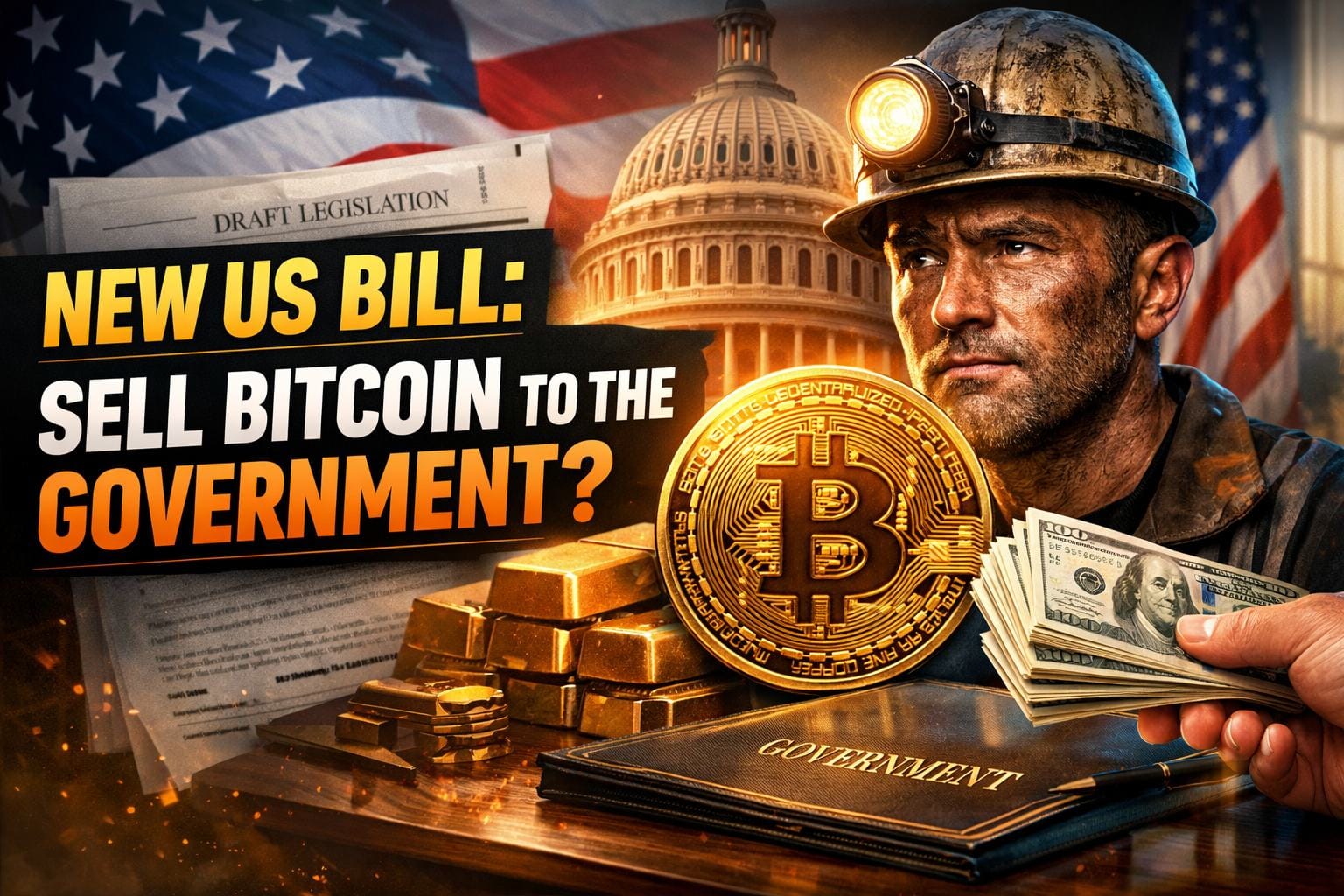
US Bill Drafted: Miners Could Sell Bitcoin to Government — Historic Shift in Digital Asset Policy
In a landmark move that could redefine the relationship between the United States government and the digital asset industry, a bipartisan group of lawmakers introduced a sweeping legislative framework last week. The proposed legislation — known informally as the “Strategic Bitcoin Reserve & Mining Integration Act” — includes a groundbreaking provision: US Bill Drafted: Miners Could Sell Bitcoin to Government under a structured, transparent mechanism. If passed, the bill would authorize domestic Bitcoin miners to sell newly minted coins directly to the Treasury, effectively creating a government-owned bitcoin stockpile while stabilizing mining revenues. This marks one of the most consequential crypto policy proposals since the inception of Bitcoin, blending national security, economic competitiveness, and energy innovation.
Washington insiders and mining executives alike are calling the draft “transformative.” With the federal government exploring ways to accumulate bitcoin without disrupting open markets, the bill introduces a voluntary framework where qualified miners can allocate a fixed percentage of their production to the U.S. government at prevailing market rates. The development arrives amid growing geopolitical interest in bitcoin as a neutral reserve asset and rising concerns about energy dependency on foreign Bitcoin mining. As we unpack the nuances, one thing becomes clear: US Bill Drafted: Miners Could Sell Bitcoin to Government signals a maturation phase for both the mining sector and federal digital asset strategy.
📰 Stay ahead of regulatory shifts: Explore the latest breaking stories, expert insights, and detailed crypto policy coverage at TechSpace Crypto News — your daily source for high-impact digital asset developments.
1. Inside the Bill: How the Miner-to-Government Sales Would Work
The core of the bill revolves around Title III — “Domestic Mining Participation & Strategic Acquisition.” Under the draft, any commercial Bitcoin mining facility operating within US jurisdiction and meeting strict criteria (including use of American-made hardware, adherence to EPA energy standards, and participation in grid-demand response programs) can register as an “Approved Domestic Producer.” Once registered, miners can offer up to 30% of their monthly freshly mined bitcoin to the United States Treasury at a price determined by a 7-day volume-weighted average from major US-regulated exchanges. The Treasury, in turn, would hold the acquired bitcoin in a newly created “National Digital Asset Reserve,” physically secured by the Federal Reserve in collaboration with the Office of the Comptroller of the Currency.
Unlike previous proposals that relied solely on open-market purchases, this mechanism leverages existing mining infrastructure, reducing market impact while providing the government with a predictable acquisition stream. The bill also creates a clear audit trail: all transactions would be recorded on a public blockchain explorer and independently verified by the Government Accountability Office (GAO) quarterly. Supporters argue this ensures full transparency, a crucial factor given past skepticism about government involvement in cryptocurrency.
Eligibility & Compliance: Raising the Bar for Miners
To prevent abuse and ensure alignment with environmental goals, the bill mandates that miners participating in the program achieve a minimum of 65% clean energy usage by 2028, with interim targets beginning 12 months after enactment. Furthermore, miners must contribute to local grid stability by offering demand response during peak load periods. These requirements are designed to address longstanding environmental criticisms while incentivizing innovation in sustainable mining. Industry groups like the Bitcoin Mining Council have expressed cautious optimism, noting that such standards could boost the industry’s reputation and unlock new institutional partnerships.
2. Strategic Rationale: Why the Government Wants Bitcoin Directly from Miners
National security experts have long advocated for the United States to acquire a strategic bitcoin reserve, viewing it as a hedge against dollar hegemony threats and a tool for cyber-financial warfare. The US Bill Drafted: Miners Could Sell Bitcoin to Government is partly inspired by the model of the Strategic Petroleum Reserve, providing a buffer against market volatility and geopolitical shocks. By sourcing bitcoin directly from domestic miners, the Treasury would strengthen the domestic mining industry, reducing reliance on foreign mining pools — particularly those concentrated in jurisdictions like China or Russia. This aligns with the White House’s recent executive order on “Strengthening Critical Infrastructure Resilience in Digital Commodity Networks.”
Additionally, the bill includes provisions for “emergency liquidity”: in extreme scenarios such as a cyberattack on financial rails, the government could leverage its bitcoin holdings as an alternative settlement layer. Supporters in the Senate Armed Services Committee point out that adversaries are already accumulating bitcoin; the US must act proactively. The bill has gained endorsements from think tanks such as the Digital Chamber and the American Enterprise Institute, framing it as a forward-looking, bipartisan solution.
Geopolitical Edge & Deterrence
Another subtle but powerful angle is deterrence. By formalizing a government bitcoin accumulation channel, the US signals its long-term commitment to the sector, potentially discouraging hostile nations from weaponizing crypto sanctions evasion. Combined with new AML frameworks, the bill represents a holistic approach: supporting compliant miners while isolating illicit actors. This aspect alone has drawn praise from both conservative and progressive lawmakers.
3. Economic Impact: Miners, Market Liquidity, and Price Discovery
What does the bill mean for mining profitability and broader Bitcoin markets? According to preliminary analysis by Galaxy Digital and independent economist Nicole Wu, the program would absorb roughly 4% to 7% of US miners’ monthly output in the first two years, equivalent to an estimated 45,000–70,000 BTC over a 3-year horizon. By removing that supply from the open market, the bill could exert gradual upward pressure on Bitcoin prices, benefiting all holders. Moreover, miners would gain a reliable counterparty, reducing the need to sell into volatile spot markets — a stabilizing factor for their balance sheets.
However, critics caution about potential overreach. Some free-market purists argue that government procurement distorts price signals and creates an uneven playing field. But bill co-author Rep. Josh Gottheimer (D-NJ) responded during a hearing: “We’re not picking winners — we’re creating an optional channel that any compliant miner can access. It strengthens American energy independence and digital resilience without imposing new taxes.” The Congressional Budget Office estimates the program would have a neutral to modest positive effect on federal revenues over ten years, assuming bitcoin’s long-term appreciation.
Clean energy target for participating miners by 2028
Maximum monthly mining output eligible for government sale
Potential government accumulation in 3 years
4. Environmental & Energy Synergies: A New Deal for Mining Communities
One of the bill’s most innovative elements is the “Energy Infrastructure Co-Investment Fund.” A portion of the bitcoin acquired from miners will be used to seed grants for renewable energy projects near mining sites — particularly in rural Texas, upstate New York, and Wyoming. Lawmakers envision a virtuous cycle: miners secure stable revenue, the government obtains bitcoin, and local communities benefit from upgraded grids, solar farms, and stranded methane mitigation projects. This provision has garnered support from environmental groups like the Clean Energy Crypto Alliance, which previously opposed mining operations. The draft bill includes $250 million in initial appropriations for the fund, signaling a genuine commitment to sustainable mining partnerships.
Additionally, the Department of Energy would be tasked with collecting data on mining energy usage to refine efficiency benchmarks. Transparency measures aim to silence critics who previously decried mining as an opaque energy consumer. With these developments, the US Bill Drafted: Miners Could Sell Bitcoin to Government stands out as a nuanced piece of legislation that marries industrial policy with climate-conscious governance.
5. Political Roadmap: Bipartisan Momentum & Opposition Hurdles
Introduced on March 24, 2026, by a coalition led by Senator Cynthia Lummis (R-WY) and Representative Ritchie Torres (D-NY), the bill currently sits before the House Financial Services Committee and the Senate Banking Committee. Early hearings indicate bipartisan interest, though significant hurdles remain. Progressive Democrats worry about legitimizing bitcoin at a time when financial inclusion gaps persist, while a handful of libertarian Republicans question the government’s role as a direct buyer of private-sector assets. Nonetheless, the bill’s focus on American miners and energy innovation has created an unusual cross-aisle coalition. According to Punchbowl News, leadership expects markups by late April, with a potential floor vote in early summer.
If enacted, the bill would require Treasury to release implementation guidelines within 180 days. Market participants are already strategizing: several public mining firms, including Riot Platforms and CleanSpark, have publicly voiced support, stating they would participate in the program to diversify revenue streams. Conversely, some smaller miners express concern about administrative burdens, though the bill includes technical assistance for small-scale operators.
“This is the most sophisticated crypto legislation I’ve seen in six years. It doesn’t just regulate — it builds infrastructure and positions the US as the undisputed leader in Bitcoin mining and strategic digital assets.” — Kristin Smith, CEO of The Blockchain Association.
6. Expert Opinions: What Economists and Miners Are Saying
Dr. Saifedean Ammous, author of *The Bitcoin Standard*, commented that the bill “represents a pragmatic acknowledgment that Bitcoin is here to stay and that governments must adapt rather than resist.” Meanwhile, Jaran Mellerud, analyst at Hashrate Index, noted that “direct government purchases from miners could flatten sell-side pressure during bear markets, ultimately reducing the industry’s dependency on debt financing.” The feedback from mining CFOs has been largely positive: a survey by The Miner Mag found that 73% of North American mining executives view the proposed mechanism as favorable to their long-term business models. Many point out that predictability in cash flows allows better planning for fleet upgrades.
However, some skeptics question the logistics of the Treasury becoming a bitcoin custodian. “We need to ensure the government doesn’t inadvertently centralize bitcoin ownership or use it as a monetary policy tool,” said Alex Gladstein of the Human Rights Foundation. The bill’s authors have responded with a strict “non-intervention clause,” prohibiting the executive branch from unilaterally selling or leveraging the reserve without congressional approval — a safeguard aimed at preserving Bitcoin’s decentralized ethos.
7. Global Ramifications: How Other Nations May Follow Suit
If the US passes this bill, analysts predict a domino effect among allied nations. El Salvador already holds bitcoin, but a formal US government acquisition program would legitimize sovereign bitcoin reserves on a massive scale. In private meetings, officials from the United Arab Emirates and Switzerland have reportedly expressed interest in similar frameworks. The bill could also impact international mining migration: jurisdictions with hostile regulations may see miners relocating to the US to access the government-backed off-take program, further cementing America’s role as the global mining hub. This would contrast sharply with the 2021 exodus of miners from China, positioning the US as the de facto safe haven for compliant, industrial-scale mining.
8. Potential Risks & Criticisms Addressed
No groundbreaking bill escapes scrutiny. Skeptics raise three primary concerns: (1) the risk of politicizing Bitcoin’s censorship-resistant nature; (2) the possibility that large miners may become too intertwined with the state, creating systemic risk; and (3) the budgetary impact if bitcoin prices drop significantly. The bill’s authors incorporated a risk-mitigation framework: any bitcoin acquired must be held for a minimum of five years, barring a national emergency declared by Congress, and Treasury is required to hedge via diversified holdings. Moreover, the program is entirely voluntary, preserving the free market for miners who prefer to sell on exchanges or OTC desks.
On the financial front, the Congressional Research Service noted that because the government would pay market prices, the program doesn’t constitute a subsidy. Additionally, the five-year holding period reduces speculative incentives. The bill’s transparency mandates — including public wallet addresses and real-time reporting — aim to give citizens visibility into the government’s bitcoin holdings, a level of openness unprecedented for federal asset reserves.
9. Next Steps: Timeline and What Comes After
As of today, March 31, 2026, the bill (designated H.R. 7834 / S. 2189) is undergoing initial committee review. The next milestone is the joint hearing scheduled for April 15, where stakeholders including mining executives, energy experts, and Treasury representatives will testify. Should the bill pass both chambers, the White House has signaled a willingness to sign, given its alignment with the administration’s “Innovation & American Energy Security” agenda. Implementation could begin as early as Q1 2027, with the first government-miner transactions expected by mid-2027.
For miners, the next few months will be crucial: registration requirements, detailed energy mix reporting, and compliance software will be developed in consultation with the Department of Energy. Forward-looking mining operations are already reviewing their sustainability metrics to qualify. Likewise, institutional investors are watching closely — the bill could unlock new categories of crypto-related ETFs and structured products tied to compliant mining revenues.
📌 Essential resources & further reading (external sources):
🔗 Congress.gov – Text of the Strategic Bitcoin Reserve Act (precedent legislation)
🔗 Cato Institute – Geopolitical implications of a US Bitcoin strategic reserve
🔗 U.S. Department of Energy – Mining & grid modernization report (2026)
🔗 The Block – Live Bitcoin mining hashrate & market data dashboard
Conclusion: A Defining Moment for Crypto Policy in America
The US Bill Drafted: Miners Could Sell Bitcoin to Government represents a paradigm shift from reactive regulation to proactive partnership. By weaving together energy independence, national security, and mining industry support, the bill’s drafters have crafted a blueprint that could serve as a model for digital asset legislation worldwide. While debates will intensify in the coming weeks, one conclusion is inescapable: Bitcoin has moved beyond the fringe and into the heart of strategic policy-making. For miners, investors, and blockchain professionals, staying informed on this legislative journey is not just recommended — it’s essential.
As the bill navigates the legislative labyrinth, we will continue to provide timely updates, expert commentary, and data-driven analysis. Bookmark our crypto policy section and follow TechSpace Crypto News for real-time developments, because when Washington rewrites the rules for digital assets, you need insights you can trust.