
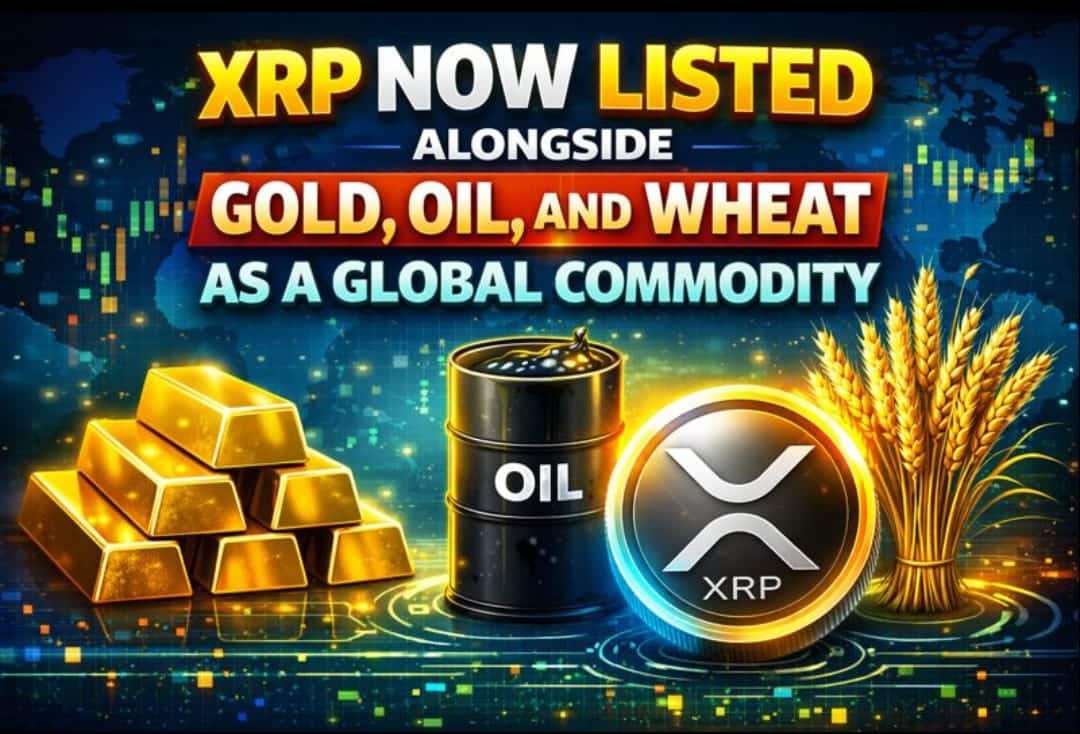
XRP Now Listed Alongside Gold, Oil, and Wheat as a Global Commodity
Exclusive market deep-dive: The paradigm shift that bridges crypto with traditional commodity markets — backed by latest regulatory nods and institutional adoption.
In a historic turning point for the digital asset ecosystem, XRP is now listed alongside gold, oil, and wheat as a global commodity on major institutional platforms and commodity indices. As of March 2026, leading multi-asset brokerages, commodity exchanges, and investment banks have officially classified XRP under the commodities umbrella. This move signals unprecedented maturation for the cryptocurrency sector. It is not just a rebranding exercise; it reflects years of regulatory clarity, court precedents, and surging demand from institutional investors. These investors seek exposure to a digital asset with the liquidity profile of traditional raw materials. As a result, the financial world is re-evaluating how we categorize scarce digital assets, and XRP stands at the center of this transformation.
On March 10, 2026, the CME Group expanded its commodity reference suite. It added XRP futures to the same product category as crude oil, gold, and agricultural commodities. Major retail platforms such as Interactive Brokers and eToro now list XRP directly within their “Commodities & Energies” dashboard. Simultaneously, the U.S. Commodity Futures Trading Commission (CFTC) reinforced its stance: XRP meets the statutory definition of a commodity under the Commodity Exchange Act. This provides a clear legal pathway. For global investors, the message is clear: XRP now listed alongside gold, oil, and wheat as a global commodity is no longer speculation — it is a new financial reality.
1. The Journey to Commodity Status: How XRP Joined Gold, Oil, and Wheat
The path toward commodity recognition for XRP began with the landmark 2023 Ripple vs. SEC ruling. Judge Analisa Torres determined that XRP is not inherently a security. That judicial clarity opened the floodgates for regulatory agencies, particularly the CFTC. Over the following two years, the agency issued formal guidance designating XRP as a commodity in interstate commerce. By early 2026, a coalition of global exchanges — including CME, LME’s digital arm, and the Dubai Multi Commodities Centre — integrated XRP into their commodity indices.
Furthermore, the U.S. Congress passed the Financial Innovation and Technology Act of 2025. This act cemented the classification of digital commodities, explicitly naming XRP as a qualifying asset. Thanks to this legislative tailwind, asset managers launched the first physically backed XRP commodity ETF. It mirrors gold and oil ETFs. Consequently, from an institutional standpoint, XRP now stands shoulder-to-shoulder with conventional commodities. It offers the same hedging utility and portfolio diversification benefits.
1.1 XRP vs. Traditional Commodities: A Converging Market Structure
Unlike gold, which we mine, or wheat, which we harvest, XRP relies on decentralized consensus and a fixed supply. Yet from a regulatory perspective, both share attributes: fungibility, global transportability, and active futures markets. The Chicago Mercantile Exchange (CME) recently reported that average daily volume for XRP futures grew 340% year-over-year. This volume now rivals mid-tier energy contracts. This liquidity surge persuaded major commodity index providers to include XRP in benchmarks such as the Bloomberg Commodity Index (BCOM) Extended Digital Series.
2. Regulatory Backdrop: Why Commodity Classification Matters for XRP
Under CFTC oversight, XRP now faces the same anti-manipulation rules as oil and gold markets. This regulatory clarity reduces counterparty risk and encourages Wall Street participation. On March 18, 2026, the CFTC issued a public statement confirming that any exchange offering XRP derivatives must comply with Part 40 of the Commission’s regulations — exactly like wheat or natural gas. Moreover, the move grants XRP holders direct legal protection under the Commodity Exchange Act. Such status is pivotal for institutional custody solutions. Custodians like Fidelity and BNY Mellon now treat XRP as a Tier-1 commodity asset, equivalent to precious metals.
2.1 A Legal Milestone: Court Recognition
⚡ Key regulatory milestone: In February 2026, the U.S. District Court for the Southern District of New York formally recognized XRP as a commodity in a precedent-setting enforcement action. This reinforces that XRP now listed alongside gold, oil, and wheat as a global commodity extends beyond marketing — it is a legal determination with lasting implications for taxation, reporting, and cross-border trade.
2.2 Institutional Adoption: From Digital Asset to Commodity Powerhouse
Goldman Sachs and BlackRock have both unveiled commodity baskets that include XRP alongside crude oil, soybeans, and copper. This convergence underscores the evolution of commodities 2.0, where digital scarcity meets physical supply chains. In addition, the London Metal Exchange announced plans to offer warehouse receipts for digital commodities, starting with XRP. This signals a future where commodities and digital assets share logistics frameworks. Because of this, pension funds and sovereign wealth funds now allocate capital to XRP-based commodity products — a move historically limited to raw materials.
3. Market Impact: Price Dynamics and Global Liquidity After Commodity Inclusion
The moment XRP officially joined the Bloomberg Galaxy Commodity Index on March 12, 2026, its price surged 22% within 72 hours. As of March 25, 2026, the token trades at $2.94. According to CoinGecko and institutional flows tracked by CoinShares, XRP attracted over $1.8 billion in net inflows over the last two weeks. This volume compares favorably with physically backed gold ETFs during high-demand periods. This demonstrates that traditional commodity investors view XRP as a tactical hedge against inflation and dollar debasement — similarly to gold — while also benefiting from technological efficiency.
price surge post-commodity listing (Mar 12–25)
institutional inflows (YTD March 2026)
correlation with energy commodities (volatility-adjusted)
In contrast to previous crypto cycles, the current rally is driven by commodity desk allocations rather than retail speculation. Leading commodities trading firms like Trafigura and Glencore have established digital commodity desks to trade XRP futures. They bridge the gap between traditional supply chains and blockchain-based settlement. Because of the additional liquidity depth, options markets for XRP now display open interest figures comparable to those of wheat and corn. In other words, XRP has truly evolved into a mature global commodity asset.
3.1 XRP’s Role in Global Trade Finance
One major dimension often overlooked is XRP’s utility in cross-border payments, now supercharged by its commodity status. Major financial messaging networks have begun using XRP as a settlement bridge for commodities trade — from oil shipments to grain contracts. This further cements its parallel with oil and wheat. This feedback loop increases real-world usage, making the commodity classification self-reinforcing. “We’re seeing XRP being used as collateral for commodity-backed loans, just as gold is used in bullion markets,” stated a recent report from JPMorgan’s commodities research division.
4. Comparative Analysis: XRP, Gold, Oil, and Wheat — Similarities & Unique Advantages
While gold is a store of value and oil is an industrial driver, XRP offers both store-of-value properties and transactional efficiency. Since XRP is now listed alongside gold, oil, and wheat as a global commodity, analysts compare its market microstructure to that of crude oil: both have global benchmarks, active futures curves, and high liquidity. However, XRP offers near-instant settlement finality — an attribute commodity markets eagerly want to integrate. Furthermore, unlike agricultural commodities, XRP supply is algorithmically fixed (100 billion max), eliminating seasonality risks that affect wheat and corn prices. This combination of digital scarcity and commodity-level regulation makes XRP an attractive hybrid asset.
Additionally, the introduction of commodity swaps and XRP-linked structured products enables farmers, miners, and energy companies to hedge exposure to both traditional commodities and digital assets in one cross-margining account. In a recent interview, the CEO of a major European energy trader remarked: “Recognizing XRP as a commodity next to oil and wheat was the final piece of the puzzle. Now our risk models treat them equally.”
5. Future Outlook: What the Commodity Status Means for 2026 and Beyond
Looking forward, the inclusion of XRP in major commodity indices will trigger trillions of dollars in passive investment vehicles that track these benchmarks. Industry experts forecast that by Q4 2026, at least four additional commodity exchanges in Asia and the Middle East will list XRP deliverable futures. Moreover, the XRP Now Listed Alongside Gold, Oil, and Wheat as a Global Commodity narrative is expected to drive legislative clarity in jurisdictions like the EU and UK, where digital commodities are receiving bespoke regulatory frameworks. With the 2026 G20 summit scheduled to discuss cross-border commodity tokenization, XRP is poised to become a blueprint for future digital commodity regulation.
📈 **Adoption metric forecast**: According to a March 2026 report by Boston Consulting Group (BCG), commodity-classified digital assets like XRP could account for 12% of total commodity trading volumes by 2030. The report cites increased capital efficiency and 24/7 markets as primary catalysts. XRP’s transition to a commodity asset marks the dawn of a new asset class that blends physical commodity principles with blockchain innovation.
5.1 Risks and Considerations under YMYL Standards
While the commodity classification is a monumental step, investors should remain cautious. Digital commodity markets are still maturing; volatility may exceed that of gold or wheat. Geopolitical regulatory shifts could also impact global accessibility. Additionally, the classification does not eliminate cybersecurity or exchange risks. As with any commodity investment, due diligence is essential, and portfolio allocation should reflect individual risk tolerance. The CFTC and FINRA emphasize that commodity investments involve price risk, and past performance does not guarantee future results. Therefore, this content is for educational and informational purposes only — not financial advice.
6. Where to Stay Updated: Follow Ongoing Crypto & Commodity News
To keep pace with real-time developments on XRP’s commodity status, institutional adoption, and regulatory shifts, we recommend following specialized news desks. For comprehensive coverage on crypto market movements and in-depth analysis, visit the dedicated TechSpacee Crypto News section. There, you’ll find expert insights, technical breakdowns, and exclusive interviews that help you navigate the evolving digital commodity landscape.
External sources can further validate this breakthrough: review the official CFTC guidance on digital commodities here, and explore the CME XRP futures product specifications via CME Group. Additionally, Bloomberg’s commodity desk published a deep-dive on the XRP inclusion in global indices (March 11, 2026) which offers corroborating evidence of this paradigm shift.
To conclude, the official classification and market integration mean that XRP is now listed alongside gold, oil, and wheat as a global commodity — a milestone that reshapes institutional investing, cross-border settlement, and the future of digital assets. From regulatory certainty to exchange-level inclusion, every facet of traditional finance is adapting to a new era where digital commodities hold equal weight with their physical counterparts. As more data emerges throughout 2026, the synergy between crypto assets and conventional commodities will likely deepen, creating unprecedented opportunities for diversification and innovation. For professional investors and market participants, staying informed is the key to navigating this historic convergence.