
YouTube Monetization Rules 2026: How to Monetize Your Channel
YouTube monetization rules 2026 have ushered in a more nuanced landscape for creators. Whether you run a commentary channel, post daily Shorts, or produce long-form documentaries, understanding the updated criteria is essential. In early 2026, YouTube refined both eligibility thresholds and advertiser-friendly guidelines, responding to creator feedback and the rise of AI-generated content. This guide delivers the latest data, including changes announced in January and February 2026, and the upcoming July 2026 revisions. We’ll walk you through the two-tier YPP system, the new 10,000 lifetime view requirement, refined controversial issues policies, and the crucial crackdown on repetitive content. If you aim to monetize your channel sustainably, these are the rules you need to master.
For broader context on digital trends and financial topics affecting content creation, you might also explore our coverage at TechSpacee Crypto News, where we analyze the intersection of technology and finance. But now, let’s dissect the monetization framework.
1. YouTube Partner Program (YPP) Eligibility: Two Tiers for 2026
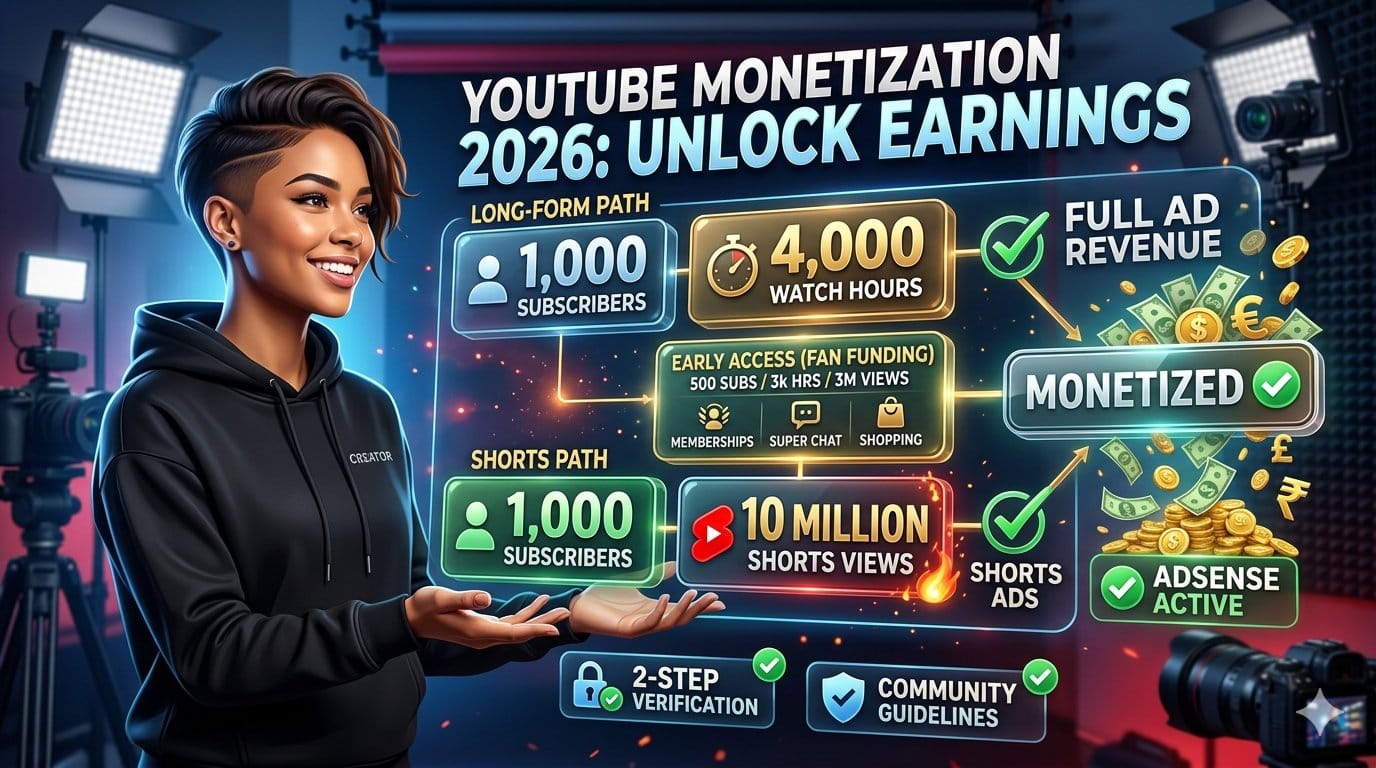
As of early 2026, YouTube maintains a dual-threshold system. The YouTube monetization rules 2026 emphasize flexibility: you can start generating revenue via fan funding at 500 subscribers, while full ad revenue requires 1,000 subscribers plus either 4,000 watch hours or 10 million Shorts views [citation:2][citation:8]. But there’s a new twist: since March 2026, channels must also cross 10,000 lifetime views before being fully reviewed for YPP [citation:3]. This is designed to combat reused content and impersonation.
1.1 Tier 1: Early Access (500 subscribers)
If your channel resides in a supported region, hitting 500 subscribers unlocks Super Thanks, Channel Memberships, and Shopping features. You need 3,000 public watch hours (long-form) or 3 million Shorts views in the last 90 days. However, you won’t receive ad revenue yet. Many creators use this phase to build community and test content.
1.2 Tier 2: Full Monetization including Ads (1,000 subscribers)
To earn ad income and YouTube Premium shares, your channel requires 1,000 subscribers plus either 4,000 public watch hours in the past 12 months or 10 million Shorts views in the past 90 days [citation:8]. Additionally, YouTube monetization rules 2026 now mandate two-step verification and a linked AdSense account. But even after meeting these, your channel undergoes a manual review that checks for community guideline strikes and “reused content.”
1.3 The New 10,000 Lifetime Views Review Gate
In a significant update rolled out in March 2026, YouTube declared that once you meet the subscriber/watch hour thresholds, your channel must also accumulate 10,000 lifetime public views before being placed into the review queue [citation:3]. This serves as an anti-abuse measure: channels that cross 10k views are scrutinized for policy compliance. According to YouTube, this ensures “revenue only flows to creators who are playing by the rules.” [citation:3].
2. Major Advertiser-Friendly Guideline Changes (Jan–Feb 2026)
Keeping up with YouTube monetization rules 2026 means understanding what content can remain fully monetized. The first quarter of 2026 brought two critical updates.
2.1 Controversial Issues: Dramatized Content Now Eligible
Effective January 2026, YouTube revised its stance on content covering topics like domestic abuse, abortion, self-harm, or adult sexual abuse. If the content is presented in a non-graphic, dramatized, or educational manner, it can now earn full ad revenue. Previously, such topics often faced limited ads regardless of treatment [citation:1][citation:10]. This change opens doors for scripted recreations, survivor stories (without graphic detail), and journalistic coverage. However, content focusing on child abuse, child sex trafficking, or eating disorders remains ineligible [citation:10].
2.2 Firearm Content: 30-Round Magazines Now Ad-Suitable
In February 2026, YouTube adjusted the firearms guideline: content featuring 30-round magazines—whether attached to a firearm or shown separately—is now eligible for ads. Earlier rules capped eligibility at 29 rounds. This change reflects a more nuanced approach to gaming and educational content [citation:1][citation:4].
2.3 Shock Content Update (March 2026)
A March 2026 policy targets “shocking content” featuring subjects (human or non-human) appearing young, in distress, with gore or body parts meant to disgust. Such content is no longer eligible to earn ad revenue [citation:5].
3. Non-Skippable Ads Expanded: More Inventory for Creators
In a welcome revenue boost, YouTube opened non-skippable ads to all YPP channels starting March 2026. Previously reserved for a select group, creators can now enable 15-20 second non-skippable spots (length varies by region). Advertisers often pay a premium for these guaranteed views, meaning higher RPMs for publishers [citation:6]. You’ll see this toggle in your YouTube Studio “Earn” tab. This is one of the most practical levers to increase ad income without altering content.
4. Cracking Down on Repetitive & Mass-Produced Content
To preserve content quality, YouTube announced a policy update effective July 15, 2026, targeting channels that rely on mass-produced or repetitive content [citation:9]. Although “reused content” has long been monetization poison, the update clarifies that reaction channels, clip compilations, and low-effort automated voiceovers will face demonetization if they lack original commentary or value. Rene Ritchie from YouTube Insider noted, “this type of content has already been ineligible for years, but the new language helps identify when content is mass produced.” [citation:9].
4.1 What counts as “repetitious” or “inauthentic”?
Examples include: channels reuploading others’ content with minimal changes, automated text-to-speech on Reddit stories without substantial modification, and template-based “shorts” that scrape viral videos. If you create original content, you’re safe. But if you run a compilation channel, you must add significant educational or transformative value.
5. Shorts Monetization: The 10 Million View Pathway
YouTube Shorts remain a powerhouse. Under YouTube monetization rules 2026, Shorts creators can qualify for YPP Tier 2 via 10 million Shorts views in 90 days (plus 1,000 subscribers). Revenue is pooled from Shorts feed ads, with 45% of the pool distributed to creators based on view share [citation:2][citation:8]. Remember: views earned before accepting the Shorts monetization module don’t count toward the revenue pool.
If you’re focusing exclusively on Shorts, note the importance of originality. The July 2026 repetitive content policy applies equally to Shorts: recycled clips from other platforms without new creative input are at risk.
6. AdSense & Revenue Splits: What You Keep
Once approved, you share revenue with YouTube. The splits remain consistent with 2025 levels [citation:2][citation:8]:
| Feature | Revenue Split (Creator / YouTube) |
|---|---|
| Long-form ads (display, overlay, skippable) | 55% / 45% |
| Super Chat, Super Stickers, Super Thanks | 70% / 30% |
| Channel Memberships | 70% / 30% |
| YouTube Premium watch time | allocated based on watch-time share |
| Shorts Feed ad pool | 45% of pool after music rights deduction |
In addition, YouTube now surfaces more granular data in the “Earn” tab regarding which videos are fully monetized (green icon) vs. limited ads (yellow icon).
7. Step-by-Step: How to Monetize Your Channel in 2026
Let’s consolidate the practical path to join YPP under the YouTube monetization rules 2026.
7.1 Pre-qualification checklist
- Subscribers: At least 500 (Tier 1) or 1,000 (Tier 2).
- Watch time / Shorts views: 4,000 hours (long) OR 10 million Shorts views (last 90 days) for ads.
- Lifetime views: Minimum 10,000 public channel views (new as of March 2026) [citation:3].
- No active Community Guidelines strikes.
- 2-Step Verification enabled on Google account.
- AdSense account linked and in good standing.
- Content originality: No repetitive, mass-produced, or reused clips without transformation.
7.2 Application steps
Open YouTube Studio → “Earn” tab → “Get started” under YPP. You’ll review monetization policies, link your AdSense, and submit. Review times average one month but can be faster [citation:2].
7.3 If rejected
First rejection: you have 21 days to appeal, then a 30-day cooldown. Second rejection: 21 days to appeal, then 90-day waiting period [citation:2]. Use the time to clean up any policy-violating videos, add more original content, and reapply.
📌 Pro tip from veteran creators: Even after approval, your channel is continuously monitored. The 2026 rules emphasize “sustained authenticity.” Avoid shortcut methods like buying views or using AI-generated scripts without fact-checking. YouTube’s YMYL (Your Money or Your Life) sensitivity means that health, financial, or news content faces higher scrutiny.
8. What’s next? Upcoming Changes to Watch
YouTube policy evolves rapidly. In late 2025 and early 2026, we saw updates on gambling, violent content age-restrictions, and medical misinformation [citation:5]. For the remainder of 2026, keep an eye on:
- AI-generated content labeling: YouTube may require disclosure for deepfakes or synthetic media; failure to label could affect monetization.
- Sensitive event monetization: The platform has clarified profiting from tragedies is not allowed, but “educational” use may be exempt.
- Music licensing in Shorts: More rules around using popular tracks; unlicensed music can lead to revenue transfer to rights holders.
To stay ahead, regularly check the official YouTube Help page on Advertiser-Friendly Guidelines.
9. External Resources and Further Reading
For authoritative updates, refer directly to YouTube‘s official Advertiser-Friendly Guidelines page which includes the latest January–February 2026 revisions. The YouTube Creators official channel also provides video deep-dives. For community insights, vidIQ’s 2026 YPP guide offers benchmarks and real creator stories.
And if you are interested in how cryptocurrency and blockchain innovations intersect with creator payouts, our Crypto News section at TechSpacee has you covered.
Final Thoughts: Navigating 2026 With Confidence
The YouTube monetization rules 2026 are more forgiving in some areas (controversial issues, non-skippable ads) and stricter in others (repetitive content, lifetime view floor). By keeping your content original, engaging, and compliant with advertiser guidelines, you position your channel for stable income. Remember: monetization isn’t just about flipping a switch—it’s about building a sustainable media asset.
Start by auditing your channel today: check your Watch Hours, Shorts views, and ensure you have no lurking policy violations. Then, methodically apply. With the right approach, the new rules can work in your favor.