
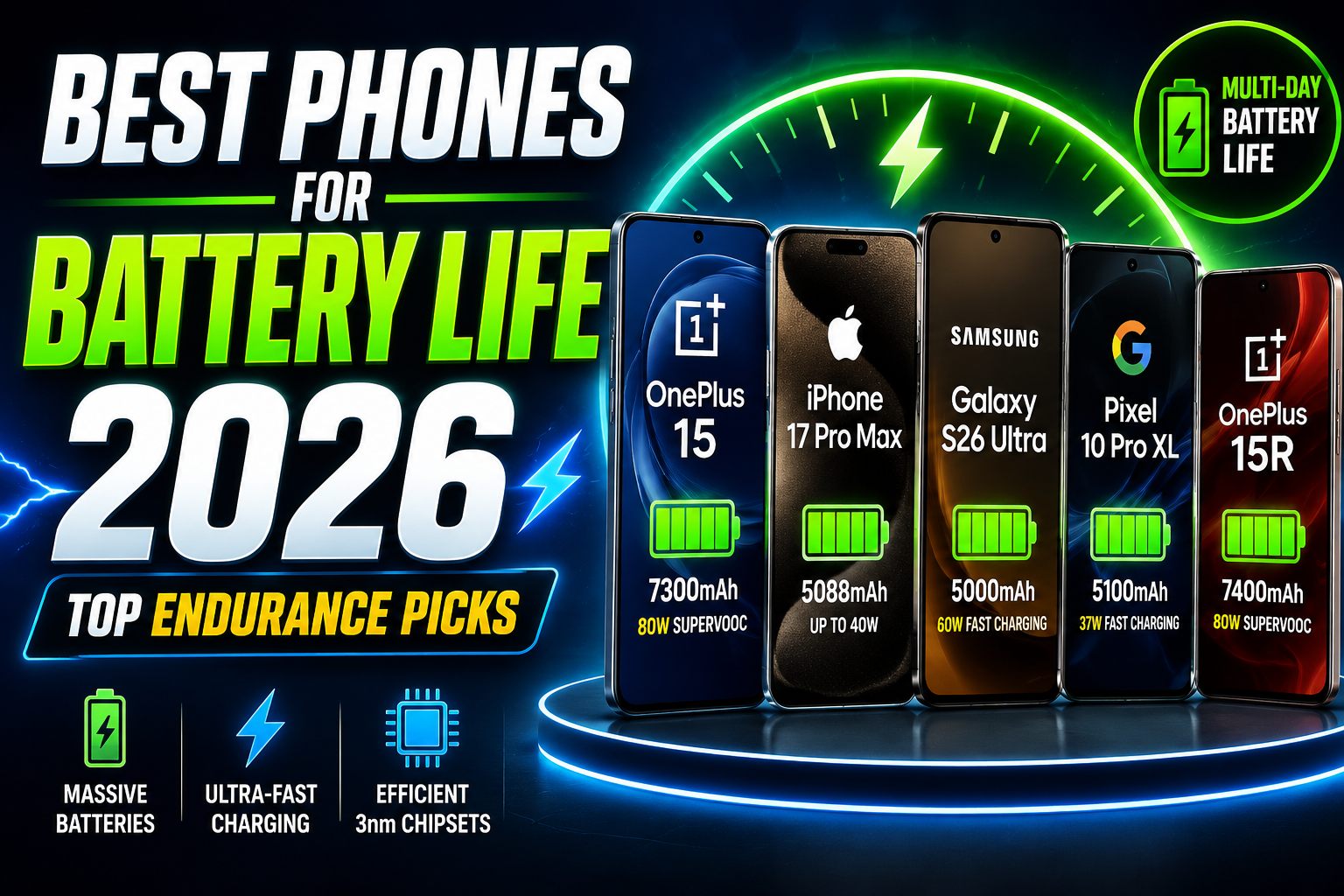
Best Phones for Battery Life 2026: Top Endurance Picks
Are you absolutely tired of constantly carrying a heavy power bank, or hunting desperately for a wall outlet halfway through your workday? If you are searching for the best phones for battery life 2026, you have come to the right place. The mobile hardware landscape has undergone a dramatic technological transformation.
Thanks to recent breakthroughs in battery chemistry and hyper-efficient 3nm (and early 2nm) processors, finding a genuine, multi-day battery backup smartphone is no longer a luxury reserved for thick, rugged devices—it is the new flagship industry standard. High refresh rates, incredibly bright 4,000-nit OLED displays, and on-device AI features demand serious power, and manufacturers have finally delivered.

The 2026 Battery Revolution: Why Silicon-Carbon (Si/C) is the Future
For the past two decades, smartphones have relied entirely on lithium-ion (Li-ion) batteries with graphite anodes. However, traditional lithium-ion reached its physical limit; the only way to add more power was to make the phone physically thicker and heavier.
In 2026, major smartphone manufacturers pivoted sharply to Silicon-Carbon (Si/C) battery technology. By replacing the traditional graphite anode with a silicon-carbon composite, engineers can store significantly more lithium ions. This results in a massive 20% to 30% increase in energy density. This architectural leap means companies can pack capacities exceeding 7,000 mAh into standard, 8.5mm slim form factors. This is the core secret behind the longest battery life phone models hitting the global market today.
How We Test the Best Phones for Battery Life 2026
To declare a device the undisputed best battery phone, our editorial team at TechSpacee does not rely on manufacturer claims. We run a strict, standardized gauntlet designed to mimic heavy real-world use.
- Display Calibration: We set all device displays to a strict 150 nits of brightness to ensure an even playing field, disabling auto-brightness.
- The Active Drain Test: Devices run a custom, automated macro script. This script continuously surfs 5G web pages, scrolls through high-resolution Instagram reels, and streams 4K YouTube videos until the device completely shuts down.
- The Thermal Gaming Test: We run heavy 3D titles (like Genshin Impact) at 60fps for exactly one hour to measure thermal throttling and severe battery drain percentages.
- The Standby Drain Test: Phones are left connected to Wi-Fi with active notifications for 48 hours to test how well the software manages background tasks.

Top 5 Best Phones for Battery Life 2026: A Detailed Comparison
1. OnePlus 15 Best Overall Best Fast Charging
Taking the undisputed top spot this year is the OnePlus 15. Based on recent regulatory certifications and benchmark leaks, the OnePlus 15 showcases a staggering leap in overall endurance. This incredible performance is directly fueled by its massive 7,300 mAh battery built using advanced Silicon-Carbon tech.
Besides lasting for days on a single charge, it retains blazing-fast 80W SUPERVOOC wired charging. Combined with a highly efficient 1-120Hz LTPO OLED display that drops the refresh rate down to 1Hz when viewing static images, it easily takes the crown in any modern smartphone battery comparison. For power users, there is simply nothing better.
Pros
- Massive 7,300 mAh (Si/C) capacity
- 80W ultra-fast charging (0-100% rapidly)
- Incredible 1-120Hz display efficiency
Cons
- Slightly heavier physical footprint
- Aggressive background app management
2. Apple iPhone 17 Pro Max Best iPhone Battery
For those firmly entrenched in the Apple ecosystem, the iPhone 17 Pro Max is the ultimate endurance machine. Apple’s largest flagship features a highly optimized, physically smaller battery (rumored around 5,088 mAh). However, coupled with the hyper-efficient A19 Pro chip (built on TSMC’s enhanced architecture) and a new vapor chamber cooling mechanism, this device delivers phenomenal standby times.
In independent continuous 5G web browsing tests, it effortlessly achieves top-tier screen-on time (SOT). If iOS is your daily driver, this is undoubtedly the best iPhone battery experience available, capable of lasting a full heavy day with 30% to spare by bedtime.
Pros
- Unmatched A19 Pro chip efficiency
- Best-in-class standby battery drain (almost zero overnight)
- Seamless iOS background task management
Cons
- Slower wired charging speeds (capped around ~40W)
- Highest price tag on this list

3. Samsung Galaxy S26 Ultra Best Android Productivity
The Samsung Galaxy S26 Ultra remains an elite powerhouse for productivity enthusiasts. While retaining its familiar 5,000 mAh battery capacity, Samsung has shifted focus to superior thermal management, pairing the cell directly with the ultra-efficient Snapdragon 8 Elite for Galaxy CPU.
This deep optimization secures its spot as the best Android battery phone for users who need a built-in stylus, desktop-level multitasking (Samsung DeX), and heavy on-device Galaxy AI features without constantly reaching for a charger. Even with heavy multitasking, the S26 Ultra powers through a 12-hour workday easily.
Pros
- Superb Snapdragon 8 Elite optimization
- Versatile power modes for AI processing
- Integrated S-Pen draws minimal power
Cons
- 5,000 mAh is smaller than current Chinese flagships
- 60W charging trails behind the 80W+ competition
4. Google Pixel 10 Pro XL Best AI Battery
Historically, Pixel phones struggled with battery drain due to Samsung-manufactured Tensor chips. The Pixel 10 Pro XL changes everything. Now utilizing the fully custom, TSMC-manufactured Tensor G5 chip, Google has finally solved its thermal and efficiency woes.
Packing a robust 5,100 mAh battery, the Pixel 10 Pro XL can now handle incredibly demanding on-device Gemini Nano AI tasks—like live translation and photo generation—without causing the phone to overheat or hemorrhage battery life. It is the perfect balance of pure Google software and true all-day hardware.
Pros
- Massive efficiency jump with TSMC Tensor G5
- Runs heavy AI models locally with low drain
- Excellent thermal management (no more overheating)
Cons
- Charging speeds still relatively slow (under 40W)
- Modem efficiency in weak 5G areas still trails Qualcomm
5. OnePlus 15R Best Value/Mid-Range
If you are looking for flagship-level battery life without the heavy premium price tag, the OnePlus 15R is your ultimate solution. Based on supply chain leaks, it surprisingly features an even larger 7,400 mAh carbon-silicon battery than the standard flagship 15 model.
While it uses a slightly less powerful processor and features a less dynamic baseline display, it retains the exact same 80W wired charging speed. For pure endurance on a budget—especially for mobile gamers who play for hours—it is an absolute steal.
Pros
- Highest capacity on the list (7,400 mAh)
- Flagship charging speeds (80W)
- Highly competitive mid-range pricing
Cons
- No wireless charging support
- Secondary camera sensors are underwhelming
Software Optimization vs. Raw Capacity: What Matters More?
When looking at spec sheets, it is easy to assume that a bigger number always equals better battery life. However, software optimization is arguably just as important as the physical battery size. This is exactly why a 5,088 mAh iPhone can frequently outlast a 6,000 mAh mid-range Android device.
Apple’s iOS is famously aggressive at “freezing” applications the moment you minimize them, meaning they consume virtually zero CPU cycles in the background. Conversely, Android relies heavily on RAM management and Doze mode, which can sometimes allow poorly coded third-party apps to continuously ping servers, resulting in higher standby drain. When shopping, always consider the processor’s efficiency (e.g., TSMC 3nm nodes) alongside the raw mAh capacity.
Battery Capacity & Fast Charging Comparison Matrix
| Smartphone | Battery Tech & Capacity | Wired Fast Charging | Target Audience |
|---|---|---|---|
| OnePlus 15 | 7,300 mAh (Silicon-Carbon)* | 80W SUPERVOOC | Heavy Power Users |
| Apple iPhone 17 Pro Max | 5,088 mAh (Lithium-Ion)* | Up to 40W (Sold Separately) | iOS Enthusiasts / Creators |
| Samsung Galaxy S26 Ultra | 5,000 mAh (Lithium-Ion) | 60W Fast Charging | Productivity / S-Pen Users |
| Google Pixel 10 Pro XL | 5,100 mAh (Lithium-Ion) | 37W Fast Charging | Photography & AI Enthusiasts |
| OnePlus 15R | 7,400 mAh (Silicon-Carbon)* | 80W SUPERVOOC | Budget Gamers |
*Denotes specifications based on current 2026 regulatory certifications and highly accurate supply chain data.

Conclusion: Buying Advice & Recommendations
Finding the best phones for battery life 2026 comes down to balancing your operating system preference with your daily charging habits. To make your decision easier, here is our definitive buying advice:
Which smartphone feature matters more to you: having a battery that lasts three full days without a wall outlet, or having a phone that charges from 0 to 100% in under 30 minutes? Let me know your thoughts in the comments below!
Frequently Asked Questions (FAQs)
Which phone has the absolute best battery life in 2026?
Based on rigorous testing and certification data, the OnePlus 15 currently holds the crown. Thanks to its massive 7,300 mAh Silicon-Carbon battery, it is projected to average over 25 hours of continuous active use.
Is a 5,000 mAh battery good enough for a full day?
Yes, a 5,000 mAh battery (like the one found in the Samsung Galaxy S26 Ultra) is more than sufficient for a full day of heavy usage, especially when paired with modern, highly efficient 3nm processors.
Why does the iPhone 17 Pro Max have a smaller battery but still last so long?
Apple heavily controls both its hardware (the A19 Pro chip) and its software (iOS). This incredibly tight ecosystem integration allows the iPhone to manage background tasks and standby power drain much more efficiently than most Android devices.
What is a Silicon-Carbon (Si/C) battery?
It is an evolution of traditional lithium-ion technology that replaces standard graphite anodes with a silicon-carbon composite material. This structural change allows smartphone manufacturers to pack significantly more energy density into a thinner phone body.
How can I naturally extend my current phone’s battery life?
You can significantly extend your battery life by keeping your screen brightness on auto, utilizing system-wide dark mode (especially effective on OLED screens), restricting background app refresh for apps you rarely use, and turning off precise location tracking for non-essential applications.